Quick answer
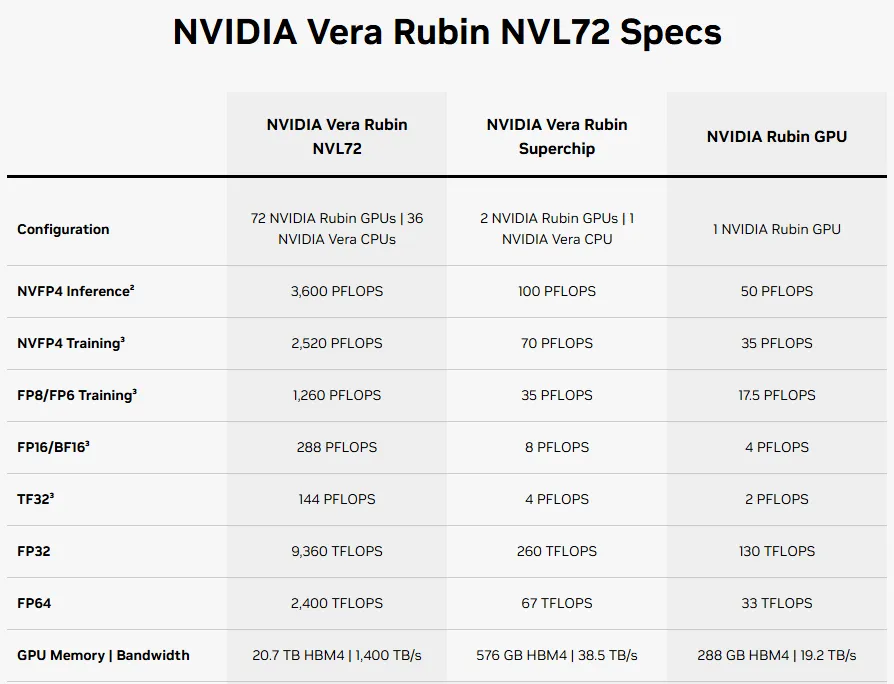
NVIDIA Rubin is the AI data-centre GPU that follows Blackwell, sold mainly as the Vera Rubin NVL72 rack with 72 Rubin GPUs, 36 Vera CPUs and 20.7 TB of HBM4 memory. NVIDIA said production shipments would start in autumn 2026, and its product page now says "Available Now". NVIDIA claims one-tenth the cost per million tokens of GB200 NVL72.
Key takeaways
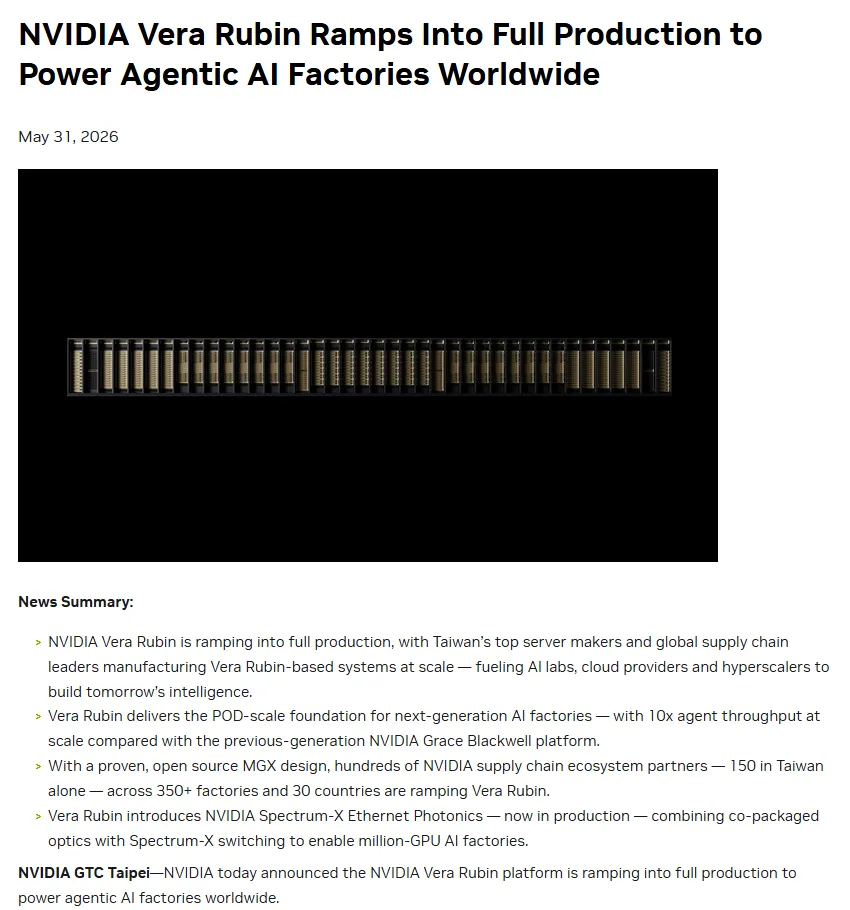
- NVIDIA said on 31 May 2026 that Vera Rubin production shipments would start in the fall; by 26 August racks were running at CoreWeave, Google Cloud, Microsoft Azure, Oracle and Nebius.
- Each Rubin GPU carries 288 GB of HBM4; a Vera Rubin NVL72 rack lists 2,520 PFLOPS of dense NVFP4 training compute versus 1,080 for Blackwell Ultra GB300 NVL72, per NVIDIA's own pages.
- Rubin depends on TSMC's CoWoS packaging and HBM4 from a handful of memory makers, the same squeeze that has pushed up RAM prices in Pakistan.
- AMD (Helios with MI450-series GPUs), Google (TPU 8t and 8i) and AWS (Trainium3) all compete, but every performance figure they publish is a vendor claim.
- For Pakistani businesses, Rubin arrives through cloud and API prices, not hardware you buy; test with APIs first, then rent GPUs, and own hardware only at heavy, steady use.
What is NVIDIA Rubin, and when does it ship?
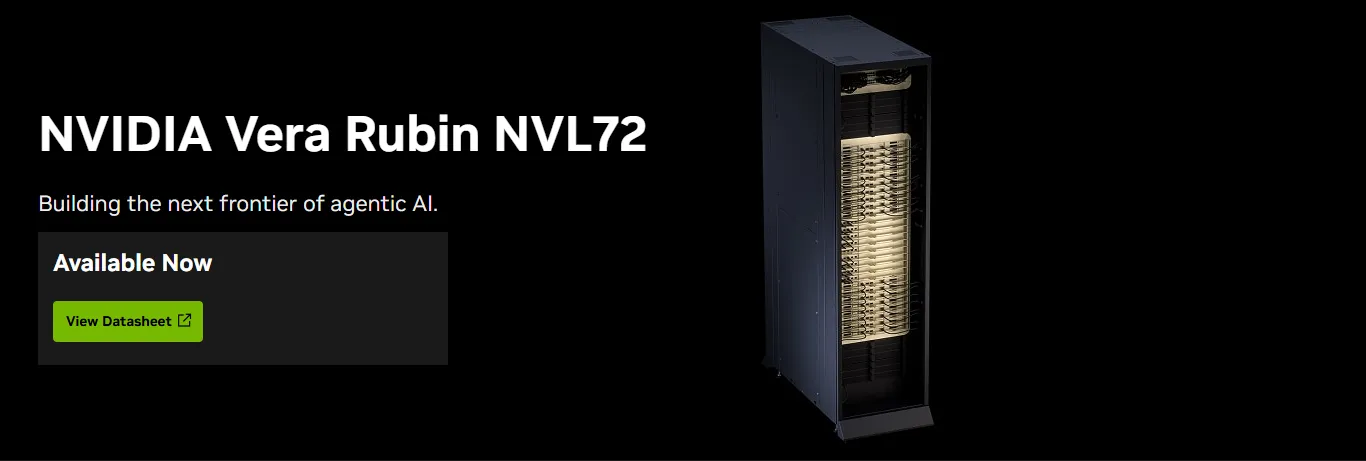
NVIDIA Rubin is NVIDIA's AI data-centre GPU that follows Blackwell. It is sold mainly inside the Vera Rubin NVL72, a liquid-cooled rack that joins 72 Rubin GPUs with 36 of NVIDIA's new Vera CPUs so they work as one giant computer (NVIDIA). A GPU (graphics processing unit) is the chip that does the heavy maths behind AI models; "Vera" is the CPU and "Rubin" the GPU.
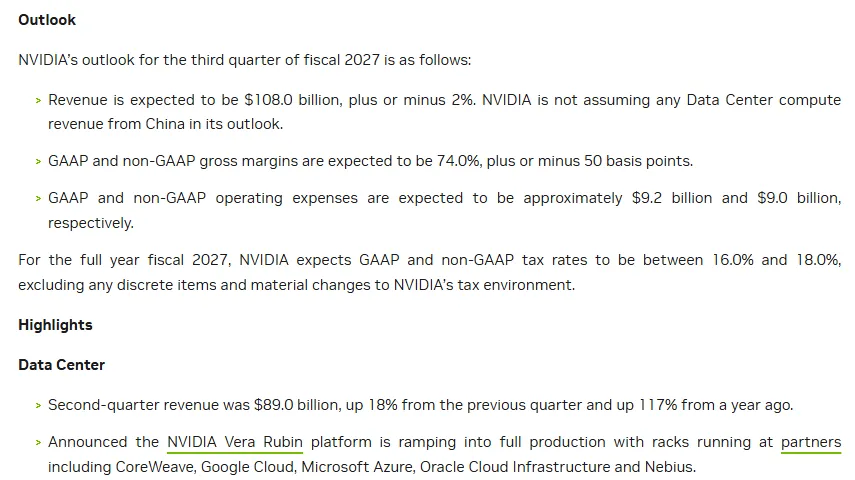
On shipping: NVIDIA said on 31 May 2026 that Vera Rubin was ramping into full production and that "production shipments of Vera Rubin are set to begin starting this fall" (NVIDIA newsroom). In its 26 August results, NVIDIA said racks were running at partners including CoreWeave, Google Cloud, Microsoft Azure, Oracle Cloud Infrastructure and Nebius. As of 15 November 2026, the product page carries the label "Available Now".
The main differences from Blackwell: Rubin uses newer HBM4 memory instead of HBM3E, pairs with the Vera CPU instead of Grace, and uses sixth-generation NVLink (NVIDIA's chip-to-chip link). NVIDIA claims Vera Rubin NVL72 delivers one-tenth the cost per million tokens of GB200 NVL72 and trains large mixture-of-experts models with one-fourth the GPUs. These are NVIDIA's own claims, based on its own tests.
Not investment advice
This article explains what is happening and how things work. It is not a recommendation to buy or sell any security. Prices move fast; check live data and speak to a licensed adviser before investing.
NVIDIA Rubin vs Blackwell: how do the specs compare?
On NVIDIA's own spec pages, a Rubin rack has about 2.3 to 3.5 times Blackwell's dense FP4 compute and about 2.4 times its memory bandwidth, in the same 72-GPU rack format. The table compares racks, because that is how these systems are sold.
| Spec (per rack, NVIDIA figures) | GB200 NVL72 (Blackwell) | GB300 NVL72 (Blackwell Ultra) | Vera Rubin NVL72 (Rubin) |
|---|---|---|---|
| GPUs and CPUs | 72 Blackwell, 36 Grace | 72 Blackwell Ultra, 36 Grace | 72 Rubin, 36 Vera |
| GPU memory | 13.4 TB HBM3E | 20 TB HBM3E | 20.7 TB HBM4 (288 GB per GPU) |
| GPU memory bandwidth | 576 TB/s | Up to 576 TB/s | 1,400 TB/s (19.2 TB/s per GPU) |
| FP4 compute, dense | 720 PFLOPS | 1,080 PFLOPS | 2,520 PFLOPS (NVFP4 training) |
| FP4 compute, sparse | 1,440 PFLOPS | 1,440 PFLOPS | 3,600 PFLOPS (NVFP4 inference) |
| NVLink bandwidth | 130 TB/s | 130 TB/s | 216 TB/s |
| CPU memory | 17 TB LPDDR5X | 17 TB LPDDR5X | Up to 54 TB LPDDR5X |
| CPU cores | 2,592 Arm Neoverse V2 | 2,592 Arm Neoverse V2 | 3,168 NVIDIA Olympus |
Two terms to know. FP4 is a very compact 4-bit number format that modern AI models use to run faster; NVFP4 is NVIDIA's version. Dense vs sparse: sparse figures assume the chip can skip zeros inside a model, which makes the headline number higher (up to double), so compare dense with dense. PFLOPS means a thousand trillion calculations per second.
Vendor claims, and figures that changed
NVIDIA's comparisons (one-tenth the cost per million tokens, up to 10x more tokens per megawatt, one-fourth the GPUs for training, all against GB200 NVL72) come from NVIDIA's own tests on specific models. NVIDIA has also revised some Rubin numbers since launch: its January 2026 release gave 3.6 TB/s of NVLink bandwidth per GPU, while the current spec table lists 3 TB/s. Always check the live table before quoting a figure.
NVIDIA Rubin release date: the timeline so far
Rubin moved from roadmap slide to shipping product in about a year and a half. Here is the sequence, with dates from NVIDIA unless stated.
- March 2025, GTC: NVIDIA's roadmap put Vera Rubin in late 2026, Rubin Ultra in late 2027 and the next architecture, Feynman, in 2028 (The Register). 2025 coverage called the rack "NVL144" because NVIDIA then counted each of Rubin's two GPU dies separately; NVIDIA's 2026 pages call it NVL72.
- 5 January 2026, CES: NVIDIA unveiled the Rubin platform, said "NVIDIA Rubin is in full production", and said Rubin-based products would be available from partners in the second half of 2026, with AWS, Google Cloud, Microsoft and Oracle among the first clouds.
- 16 March 2026, GTC: NVIDIA expanded the platform to seven chips, adding the Groq 3 LPU inference accelerator, across five rack types.
- 31 May 2026, GTC Taipei: "ramping into full production", with partners building across 350+ factories in 30 countries and shipments due to begin in the fall.
- 7 June 2026: NVIDIA and SK hynix announced a multiyear partnership on next-generation memory for Vera Rubin and other platforms.
- 26 August 2026: second-quarter results said Vera Rubin racks were running at CoreWeave, Google Cloud, Microsoft Azure, Oracle Cloud Infrastructure and Nebius.
- 2027 (expected): Rubin Ultra. TrendForce expects it to raise HBM per GPU to 384 GB.
What does Rubin depend on? TSMC packaging and HBM4 memory
Rubin can only ship as fast as two bottlenecks allow: advanced packaging at TSMC and HBM4 memory from a few suppliers.
- Packaging (CoWoS). CoWoS is TSMC's advanced packaging that places GPU dies and HBM memory stacks side by side on a silicon base so they can talk at very high speed. TrendForce reported on 30 April 2026 that the CoWoS shortage had spread to production equipment, substrates and packaging materials, and that NVIDIA had "preemptively secured" large volumes of 4/3nm wafer capacity, CoWoS packaging, substrates and HBM. It cited TSMC's plan to expand CoWoS capacity by over 60% by 2027 and expects the shortage to ease only slightly by then (TrendForce).
- Memory (HBM4). Each Rubin GPU carries 288 GB of HBM4. The three major HBM makers are SK hynix, Samsung and Micron, which also held almost 88% of all DRAM revenue in 2Q26. NVIDIA signed a multiyear memory partnership with SK hynix in June 2026 to secure supply. TrendForce estimates HBM will take about 22% of DRAM wafer input by the end of 2026 and about 30% by the end of 2027 (TrendForce).
That last point reaches Pakistan directly. Every wafer that becomes HBM for an AI rack is a wafer that does not become RAM for a laptop, which is a big part of why the RAM price in Pakistan in 2026 keeps climbing. NVIDIA itself lists "reliance on third parties to manufacture, assemble, package and test" its products among its business risks.
NVIDIA vs AMD, Google TPUs and custom chips: who are the competitors?
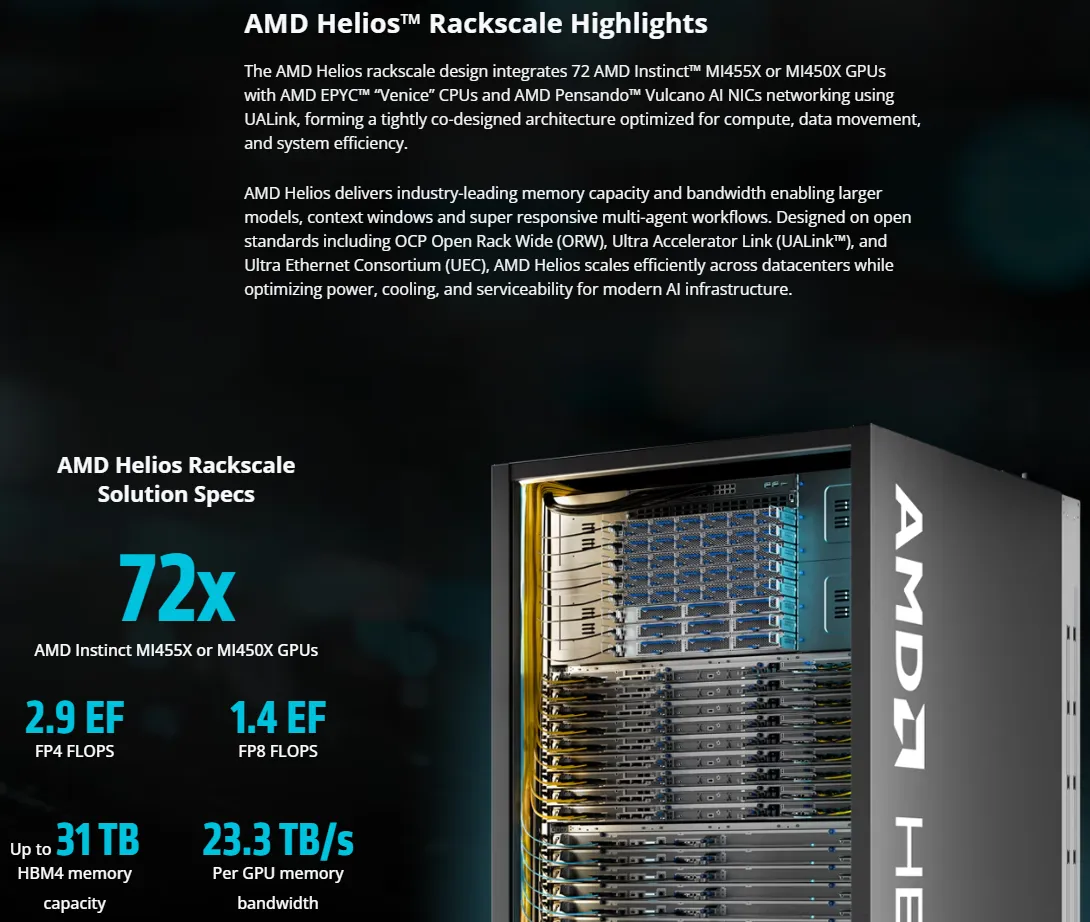
NVIDIA still leads, but AMD now ships a rack-scale rival and the big clouds design their own chips. Every figure below is a claim by the company that makes the chip.
| Company | Chip or system | Status (15 November 2026) | Headline vendor claim |
|---|---|---|---|
| NVIDIA | Vera Rubin NVL72 | Product page says "Available Now" | One-tenth the cost per million tokens of GB200 NVL72 |
| AMD | Helios rack with 72 Instinct MI455X or MI450X GPUs | AMD reported the launch of MI450-series GPUs on 3 November 2026 | 2.9 exaflops FP4, up to 31 TB HBM4, 23.3 TB/s per GPU |
| TPU 8t (training) and TPU 8i (inference) | Listed as "Coming soon" on Google Cloud | TPU 8t: nearly 3x compute per pod; TPU 8i: 80% better performance per dollar | |
| AWS | Trainium3 (Trn3 UltraServers) | Generally available since 2 December 2025 (AWS) | Up to 144 chips per UltraServer; up to 4.4x the compute of Trainium2 UltraServers |
NVIDIA vs AMD. AMD's third-quarter results on 3 November 2026 showed data-centre revenue of $8.5 billion, up 97% from a year earlier, driven by EPYC CPUs and "the launch of AMD Instinct MI450 Series GPUs". AMD said Anthropic, Meta, Microsoft, OpenAI and Oracle Cloud Infrastructure were running workloads on the first Helios systems, and guided fourth-quarter revenue to about $17 billion (AMD). NVIDIA's biggest advantage remains software: most AI tools are built first for CUDA, NVIDIA's programming platform, while AMD's alternative is ROCm.
Google and the clouds. Google sells both: its own TPUs (tensor processing units, its custom AI chips) and NVIDIA racks, since NVIDIA lists Google Cloud among the partners running Vera Rubin. AWS does the same with Trainium. For a buyer, that means more choice of where AI runs, not just which chip.
NVIDIA and China: where do H20 and H200 sales stand?
As of 15 November 2026, the US allows some H200 sales to China under licence, but Beijing has not cleared large-scale imports, and NVIDIA's guidance assumes no China data-centre revenue at all.
The NVIDIA H200 is a Hopper-generation GPU, two generations behind Rubin, with 141 GB of HBM3E memory (NVIDIA). The timeline:
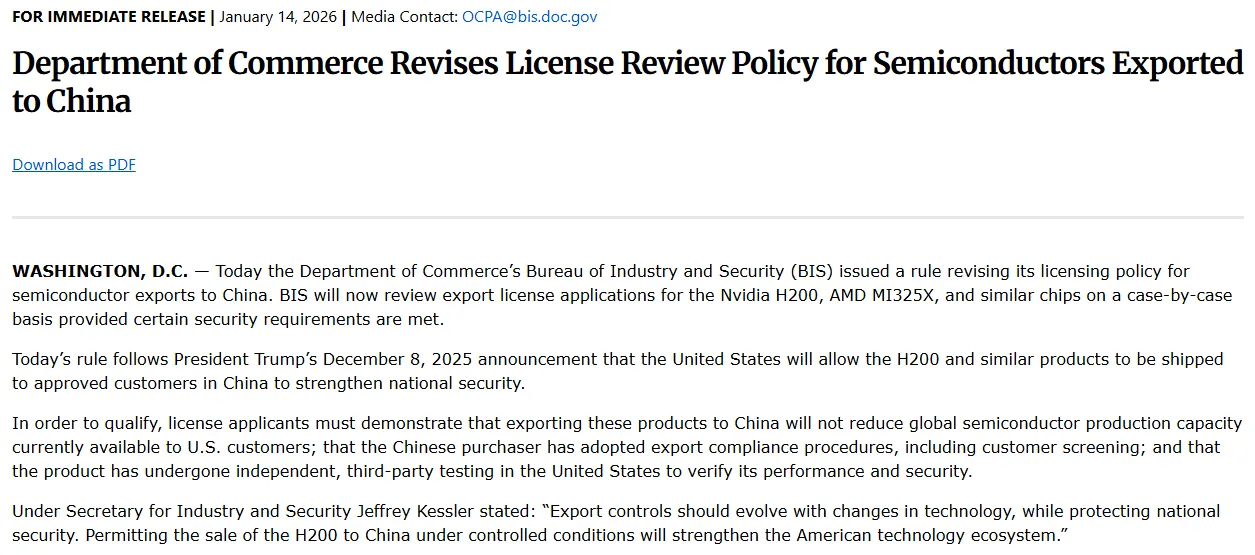
- 14 January 2026: the US Commerce Department's Bureau of Industry and Security (BIS) moved licence applications for the H200, AMD MI325X and similar chips to case-by-case review, if the buyer has export-compliance procedures, the chips pass independent US testing, and exports do not reduce capacity available to US customers (BIS).
- May 2026: Reuters reported that about 10 Chinese companies, including Alibaba, Tencent, ByteDance and JD.com, had been approved to buy H200s, up to 75,000 each, but that no chips had been delivered.
- 5 November 2026: Reuters reported that about 600,000 H200s were sitting in Hong Kong because Beijing had not cleared large-scale imports, and that total approved foreign chips could end up below 200,000 (Reuters).
- NVIDIA's own position: its outlook for the third quarter of fiscal 2027 says it "is not assuming any Data Center compute revenue from China", which covers the China-specific H20 as well as the H200.
How do the CEO change and the 17 November earnings fit in?
They are the next two tests of whether the Rubin ramp stays on track. On 12 November 2026 NVIDIA announced that Jensen Huang "has resigned as President, Chief Executive Officer, and a member of the Board, effective immediately". CFO Colette Kress is serving as interim CEO while remaining CFO, Harvey C. Jones was appointed board chair, and the board is searching for a permanent CEO (NVIDIA filing on SEC EDGAR). Our report on NVIDIA's new CEO covers what is known so far.
NVIDIA reports third-quarter fiscal 2027 results on Tuesday 17 November, with the call at 2:00 p.m. Pacific time, which is 3:00 a.m. Wednesday 18 November in Pakistan. Its guidance is $108.0 billion, plus or minus 2%. For Rubin, listen for how much revenue Vera Rubin contributed, comments on HBM4 and packaging supply, any change on China, and whether the leadership change affects plans. Our NVIDIA earnings date guide has the full checklist.
AI chips stocks such as NVIDIA, AMD, TSMC, SK hynix and Micron often move together on news like this. We make no predictions. Be wary of anyone selling "guaranteed NVIDIA profits" through WhatsApp groups, deepfake videos or offshore apps; see our guide to AI scams in Pakistan.
What does Rubin mean for businesses in Pakistan using AI?
You will almost certainly never buy a Rubin rack; you will feel Rubin through cloud and AI API prices. Rubin goes first to the big clouds and GPU cloud providers. If NVIDIA's cost-per-token claims hold, providers gain room to cut prices, but whether they pass savings on is their choice.
What cloud GPUs cost today. Lambda's published price list, effective 16 November 2026, shows $4.89 per GPU-hour for a single NVIDIA H100 and $7.99 for a single B200 (Blackwell), plus tax (Lambda). At SBP's 13 November rate of 276.60, that is about Rs 1,353 and Rs 2,210 an hour. Paying by Pakistani card adds 236Y advance tax (0.5% or 1%), as our card payments guide explains. Compare that with an RTX 5090 at Rs 2.85 million or more in Pakistani shops.
| Option | Upfront cost | Best for | Watch out for |
|---|---|---|---|
| AI API (pay per token) | None | Chatbots, document search, content tools, most SMEs | Monthly bill grows with usage; data leaves your servers |
| Rented cloud GPU | None; pay per hour | Fine-tuning, running open models, short projects | Idle hours still cost money; card limits and 236Y tax |
| Own GPU server or workstation | High (hardware, power backup, cooling) | Heavy, steady, all-day workloads or strict data rules | Load-shedding, repairs, resale value, staff skills |
A step-by-step way to decide
- Write down the job. For example: "answer customer questions on WhatsApp in Urdu and English" or "summarise 500 invoices a day". Done looks like one sentence and a monthly volume estimate.
- Start with an API. Build a small pilot on a hosted model and run it for two to four weeks. Record tokens used and the monthly bill. Common mistake: buying hardware before you know your real volume.
- Check data rules. If customer, patient or financial data cannot leave your control, note it now; it may force a private deployment.
- Price the rented-GPU option. If you need an open model or fine-tuning, estimate GPU-hours a month and multiply by the provider's hourly rate. Turn instances off when idle.
- Price ownership honestly. Include hardware at today's Pakistani prices, UPS and generator backup, cooling, spare parts and staff time, spread over the years you expect to use it.
- Design to switch. Keep prompts, data and code independent of one model or chip vendor, so you can move to whatever becomes cheaper as Rubin, AMD and TPU capacity reaches the clouds.
- Review every quarter. GPU and API prices are moving fast in both directions. Re-run the numbers each quarter.
Our AI integrations team does exactly this comparison for clients, and our guide to AI WhatsApp agents shows a typical API-first project.
What mistakes should you avoid when reading NVIDIA Rubin news?
- Comparing sparse with dense. A sparse figure can be up to double the dense one. Compare like with like.
- Treating vendor claims as independent results. "10x lower cost per token" is NVIDIA's own test on chosen models; AMD's and Google's numbers are their own too.
- Mixing up names. NVL144 (2025 naming) and NVL72 (2026 naming) describe the same Vera Rubin rack; Rubin Ultra is a later, 2027 product.
- Assuming your AI bill falls tomorrow. New hardware can take months to reach most cloud regions and price lists.
- Acting on stock tips from social media. Chip news moves share prices fast, and scammers use it as bait.
How Digitt Hype can help
Digitt Hype's AI Integrations team helps Pakistani businesses choose between cloud AI APIs, rented GPUs and owning hardware, and builds AI tools that do not depend on a single chip vendor. Tell us what you want to automate, and we will give you a plain cost comparison before you spend on hardware.
Frequently asked questions
What is the NVIDIA Rubin release date?
NVIDIA unveiled Rubin at CES on 5 January 2026 and said partners would offer Rubin products in the second half of 2026. On 31 May 2026 it said production shipments would begin in the fall. By 26 August 2026 racks were running at several cloud partners, and on 15 November 2026 NVIDIA's Vera Rubin NVL72 page said "Available Now".
Is NVIDIA Rubin better than Blackwell?
On NVIDIA's spec pages, a Vera Rubin NVL72 rack lists 2,520 PFLOPS of dense NVFP4 training compute against 1,080 PFLOPS for Blackwell Ultra GB300 NVL72, and 1,400 TB/s of memory bandwidth against 576 TB/s. NVIDIA also claims one-tenth the cost per token of GB200 NVL72. Independent benchmarks will show how much of that holds in real workloads.
Can China buy the NVIDIA H200?
The US moved H200 export licences for China to case-by-case review on 14 January 2026, and Reuters reported in May that about 10 Chinese firms were approved. But on 5 November 2026 Reuters reported about 600,000 H200s waiting in Hong Kong because Beijing had not cleared large-scale imports. NVIDIA assumes no China data-centre revenue in its outlook.
What is the difference between NVIDIA Rubin and Rubin Ultra?
Rubin is the GPU shipping in 2026 inside the Vera Rubin NVL72 rack, with 288 GB of HBM4 per GPU. Rubin Ultra is the follow-up NVIDIA placed in 2027 on its roadmap. TrendForce expects Rubin Ultra to raise HBM capacity to 384 GB per GPU. Detailed Rubin Ultra specifications have not been fully published.
Who are NVIDIA's main competitors in AI chips?
AMD sells Instinct MI450-series GPUs in its 72-GPU Helios rack, which AMD says Anthropic, Meta, Microsoft, OpenAI and Oracle are using. Google designs TPUs, with TPU 8t and 8i listed as coming soon on Google Cloud. AWS offers Trainium3. Each publishes its own performance claims, so compare them carefully.
Will NVIDIA Rubin make AI cheaper for Pakistani businesses?
Possibly, over time and indirectly. Rubin goes to big cloud providers first, and NVIDIA claims much lower cost per token. Whether API and GPU rental prices fall depends on those providers. Meanwhile, start with pay-per-use APIs, rent GPUs for short projects, and buy hardware only for heavy, steady workloads.
Sources 10
- NVIDIA: Vera Rubin NVL72 product page and specifications
- NVIDIA: GB300 NVL72 specifications
- NVIDIA Newsroom: Vera Rubin ramps into full production (31 May 2026)
- NVIDIA: Kicks off the next generation of AI with Rubin (5 January 2026)
- NVIDIA Newsroom: Financial results for second quarter fiscal 2027 (26 August 2026)
- SEC EDGAR: NVIDIA announces CEO transition (12 November 2026)
- BIS: Commerce revises license review policy for semiconductors exported to China (14 January 2026)
- TrendForce: AI competition tightens advanced packaging and 3nm capacity (30 April 2026)
- AMD: Third quarter 2026 financial results (3 November 2026)
- Lambda: GPU cloud pricing (effective 16 November 2026)
Numbers not matching your dashboard?
That gap is worth an hour of someone’s time. Tell us what you see and we will look at it with you.