Quick answer
AI SEO means making your pages easy for AI answers such as Google AI Overviews, AI Mode and ChatGPT search to find, trust and cite. Google says there is no special trick: index-ready pages that answer questions directly, show real expertise and keep business data accurate. Measure it in Search Console's Generative AI report.
Key takeaways
- AI Overviews support Urdu and AI Mode launched in Pakistan in English in August 2025; Google announced Urdu for AI Mode in October 2025.
- Studies link AI summaries to fewer clicks: Pew found clicks on traditional results fell from 15% to 8% of visits when a summary appeared.
- Google's own guide says AI search optimisation "is still SEO": no llms.txt, special markup or chunking is needed for Google.
- Answer-first pages, real authors, accurate structured data and a complete Business Profile are the proven basics.
- Track AI visibility with Search Console's Generative AI report, Bing's AI Performance report and a GA4 channel for AI assistants.
What changed: AI Overviews and AI Mode in Pakistan
AI SEO matters now because Google, ChatGPT, Copilot and Perplexity increasingly answer a question on their own page, with a few cited links, instead of showing ten blue links. If your business is not one of the cited sources, you can be invisible even when you "rank".
Here is where things stand in Pakistan as of November 2026:
- AI Overviews are the AI-written summaries at the top of some Google results. Google said in May 2025 they were available in over 200 countries and territories and more than 40 languages, adding Urdu among others (Google).
- AI Mode is a separate, chat-style search tab for longer questions and follow-ups. Google launched it in Pakistan in English in August 2025 (Dawn), and announced AI Mode in Urdu and six other languages in October 2025 (Google India blog). That announcement was framed around India, so check Urdu support yourself by setting Google's language to Urdu.
- ChatGPT search, Microsoft Copilot and Perplexity also answer with citations, and many Pakistani users, especially students and professionals, now start research there.
AI Overviews vs AI Mode: what is the difference?
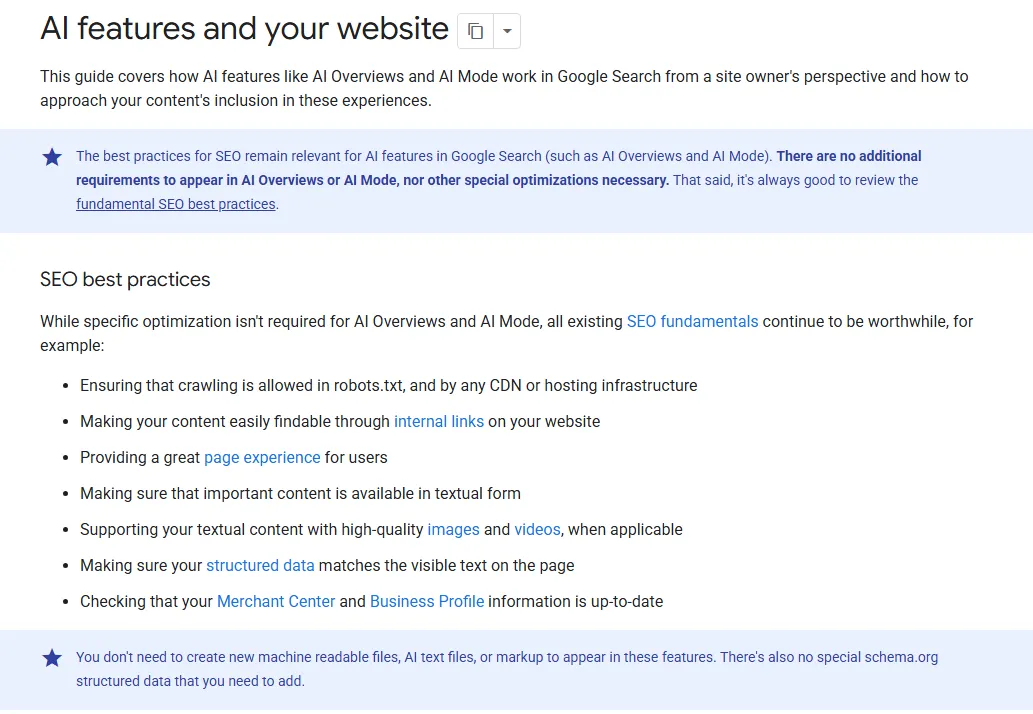
AI Overviews appear on a normal results page only when Google decides a summary adds something; AI Mode is a full conversation where you ask follow-up questions. Google says both may use "query fan-out", meaning they run many related searches behind the scenes and can cite a wider set of pages than a classic result (Google Search Central: AI features and your website).
One more change matters for old "SEO checklists": Google stopped showing FAQ rich results from 7 May 2026 and removed the documentation in June 2026 (Search Central documentation updates). FAQ markup no longer earns those expandable questions in Google's results.
Why AI answers hurt Pakistani businesses that ignore them
AI answers reduce clicks to ordinary results, so the same ranking brings fewer visitors. The research so far is from other markets, mostly the US, but the direction is clear.
- Pew Research Center tracked 900 US adults in March 2025. When an AI summary appeared, people clicked a traditional result in 8% of visits, compared with 15% without one. They clicked a link inside the summary in only 1% of visits, and ended their browsing session more often (26% versus 16%).
- Ahrefs compared 300,000 keywords in December 2025 with December 2023 and found the presence of an AI Overview was associated with a 58% lower click-through rate for the top-ranking page. That is a correlation, not proof of cause.
For a Pakistani business the hit lands on informational searches: "best age for braces", "how much does a website cost", "O level vs Matric". If a clinic, school or online store relied on blog traffic from questions like these, fewer people now click through. The ones who do click are often further along, which makes being the cited source more valuable, not less.
There is a second problem: the market for "AI SEO services in Pakistan" is full of promises to "rank you in ChatGPT" using secret tricks. Google's guidance, below, says most of those tricks do nothing for Google Search. Be sceptical of anyone selling them.
What is answer engine optimization, and what actually works?
Answer engine optimization (AEO) is the practice of making your content easy for AI answer tools to find, understand and quote. Google's position, updated July 2026, is that for Google Search optimising for generative AI "is still SEO" (Google: Optimizing your website for generative AI features).
The same guide lists things you can ignore for Google Search:
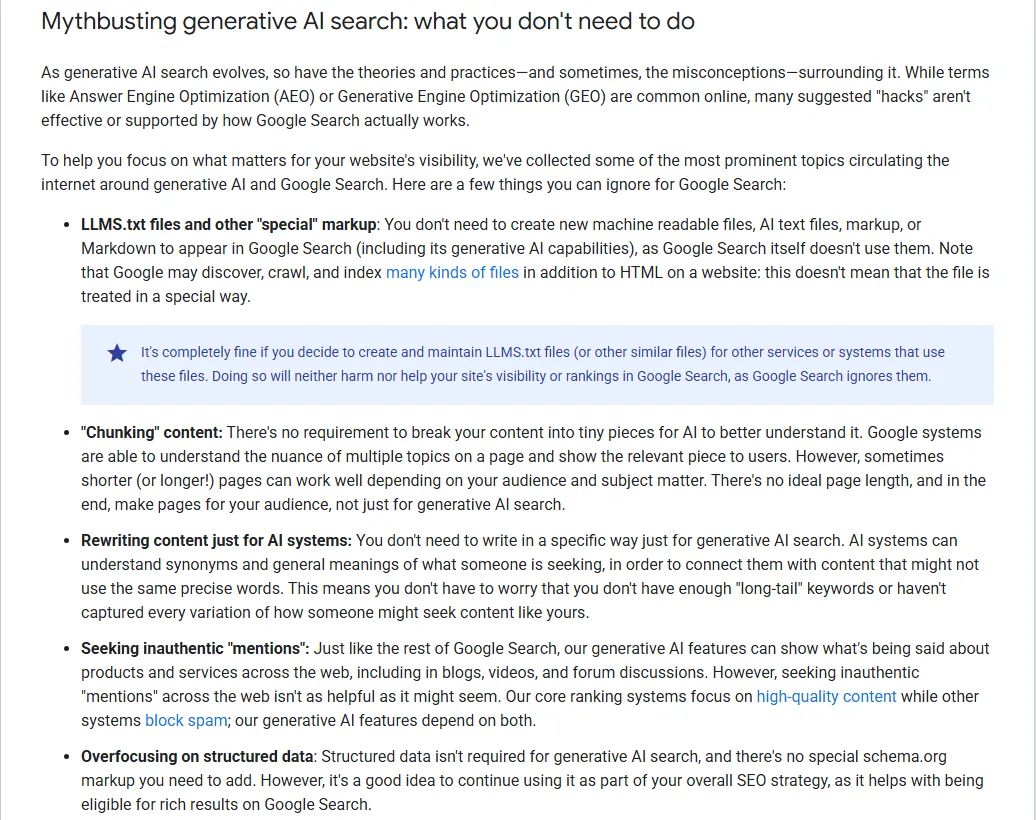
So what is proven and what is guesswork? Here is our honest split:
| Tactic | Status | Why |
|---|---|---|
| Indexable pages with a snippet allowed | Required | Google says a page must be indexed and eligible for a snippet to be a supporting link |
| Clear, direct answers written for people | Supported by Google guidance | Google asks for helpful, original, people-first content |
| Accurate Business Profile and Merchant Center data | Supported by Google guidance | Google says these can help local businesses and products appear in AI responses |
| Structured data that matches the page | Helpful, not required for AI | Needed for rich results; Google says no special schema is needed for AI features |
| Allowing OAI-SearchBot in robots.txt | Required for ChatGPT search | OpenAI says this bot surfaces sites in ChatGPT search results |
| llms.txt file | Speculative | Google ignores it for Search; some other tools may read it |
| Splitting pages into tiny "chunks" | Not needed for Google | Google says its systems find the relevant part of a page |
| Buying mentions or mass-producing pages for every query variation | Risky | Google warns this can break its spam policies |
Should you publish in Urdu or Roman Urdu?
Publish in the language your customers search in. AI Overviews support Urdu, so if your customers search in Urdu script, an Urdu page gives Google something to cite in that language. Use real Unicode Urdu text, not images of text, and give each language version its own URL with hreflang tags so Google knows which page to show to whom. Roman Urdu is different: there is no standard spelling, so people type "kitnay", "kitne" and "kitna" for the same word. Rather than building Roman Urdu pages, use the common Roman Urdu phrases you find in Search Console and your chats naturally in headings and answers on your English pages.
How do you check if AI search is already sending you traffic?
Check three places: Google Search Console, Bing Webmaster Tools and Google Analytics 4. Together they show whether AI answers show your pages and whether anyone clicks through.
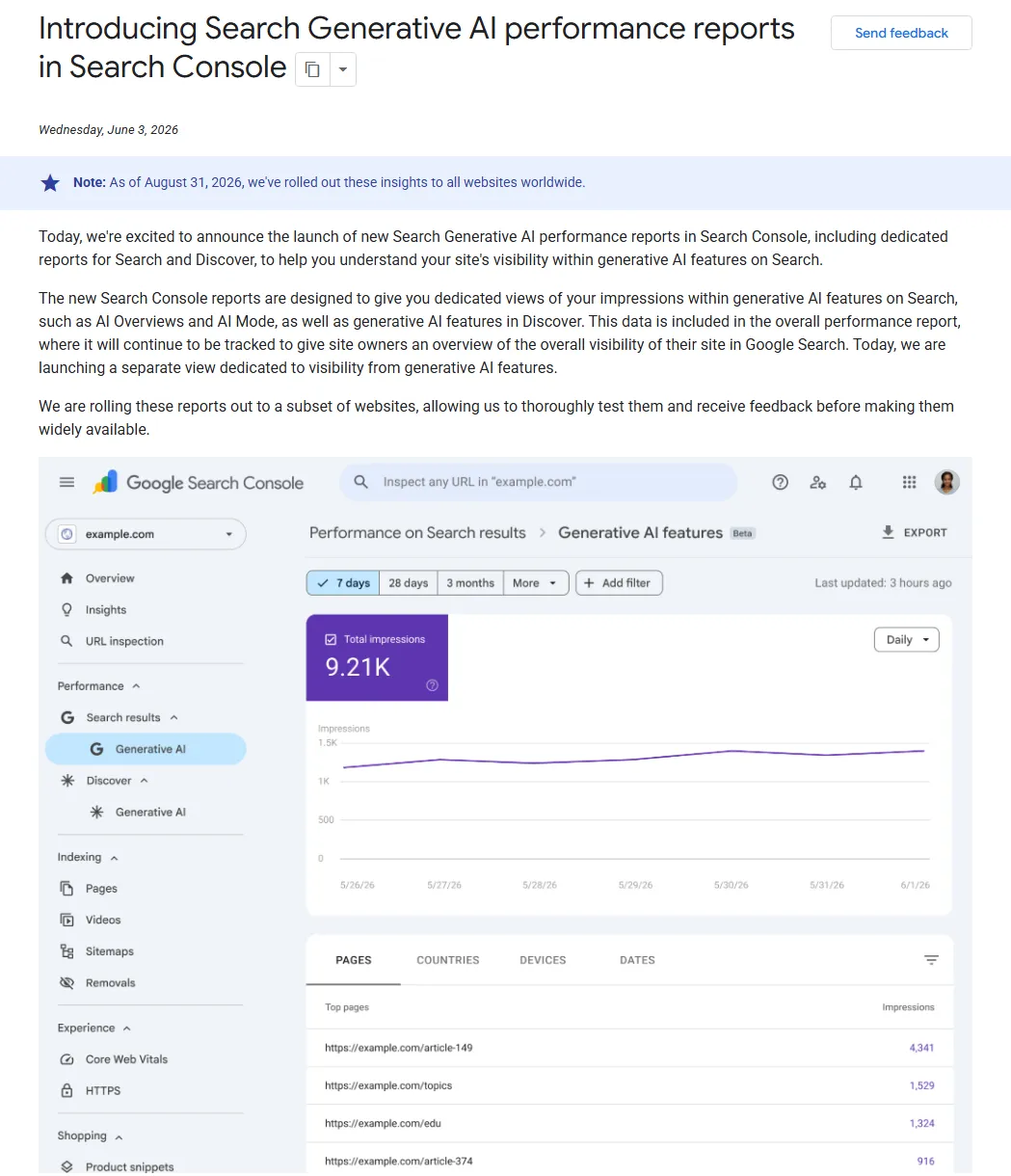
- Search Console Generative AI report. Google launched dedicated Generative AI performance reports on 3 June 2026 and says they reached all websites worldwide by 31 August 2026. They show impressions in AI Overviews, AI Mode and Discover's AI features, by page, country, device and date. Open Performance → Search results → Generative AI.
- Bing AI Performance report. Bing Webmaster Tools added an AI Performance report in public preview in February 2026. It shows how often your pages are cited in Microsoft Copilot, AI summaries in Bing and some partner integrations (Bing Webmaster Blog).
- GA4 referrals. In Reports → Acquisition → Traffic acquisition, set the dimension to Session source and look for chatgpt.com, perplexity.ai, gemini.google.com and copilot.microsoft.com. Clicks from AI Overviews and AI Mode arrive as normal Google organic traffic, so they will not show up separately here.
How to do AI SEO step by step
Follow these steps in order. None of them is a trick; together they make your site the obvious source to cite.
- Find the questions your customers ask. Type your service into Google and note the autocomplete suggestions and the People also ask box. In Search Console open Performance → Search results → + Add filter → Query → Custom (regex) and paste
^(how|what|why|which|can|is|does|kya|kaise|kitna)\bto list question searches you already appear for. Include Roman Urdu and Urdu phrasings. Done looks like: a sheet of 20 to 50 real questions grouped by topic. - Write answer-first pages. Put the direct answer in the first one or two sentences under each heading, then the detail. Use the customer's question as the heading where it reads naturally. Give real numbers with sources: prices in Rs, timeframes, requirements. Done looks like: someone who reads only the first line of each section still gets the answer.
- Add what only you know. Google asks for original, first-hand content. A Karachi clinic can explain its actual consultation process; a Lahore school can publish its real fee structure and admission dates; a store can show its delivery times by city. AI tools have plenty of generic text; they lack your specifics.
- Add accurate structured data. Structured data (schema) is code that labels facts on a page for machines. Use
Organizationon your home page,LocalBusiness(or a subtype such asDentistorRestaurant) with name, address, phone and hours, andArticlewith author and dates on blog posts. Test each template in the Rich Results Test and the Schema Markup Validator. The markup must match what visitors see. FAQ markup is still valid schema, but Google no longer shows FAQ rich results, so do not expect a visual gain from it.
Paste a URL or code into the Rich Results Test to check your structured data for errors before and after publishing. Source: Google Rich Results Test. - Show real expertise (E-E-A-T). E-E-A-T stands for experience, expertise, authoritativeness and trust, the qualities Google's quality raters are asked to look for. In practice: a named author with a short bio and credentials on every article, links to sources, a visible "last updated" date, and full contact details. For health pages, have a qualified doctor write or review them and say so.
- Make sure crawlers can reach you. In robots.txt, allow Googlebot and Bingbot. If you want to appear in ChatGPT search, allow
OAI-SearchBot; OpenAI says blocking its separate training crawler, GPTBot, does not affect search (OpenAI crawlers). Check that important pages are not blocked bynoindexornosnippet, and that your CDN or firewall is not blocking bots. - Set up Bing Webmaster Tools. Add your site at bing.com/webmasters (you can import it from Search Console), submit your sitemap and check the AI Performance report. Bing powers Copilot, and in 2023 Microsoft said it would offer Bing as the default search engine in ChatGPT (CNBC). How much ChatGPT search relies on Bing today is not published, but a Bing setup costs little.
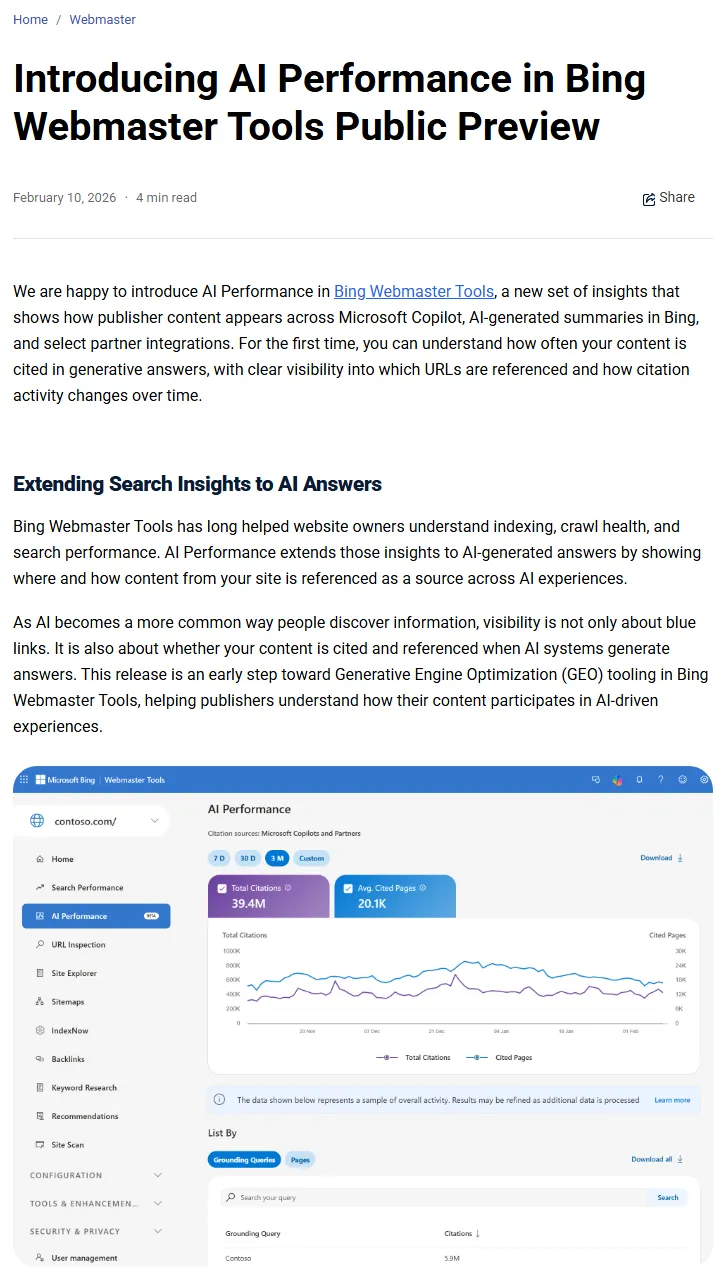
Bing's AI Performance report shows total citations, average cited pages and the "grounding queries" that led AI answers to your content. Source: Bing Webmaster Blog. - Complete your Google Business Profile. For "near me" and city searches, AI answers draw on Business Profile data and reviews. Our Google Business Profile guide walks through it.
- Keep your facts the same everywhere. AI answers pull from your website, your Business Profile, directories and social pages. If your phone number, address, opening hours or prices differ between them, the answer may be wrong or may skip you. Pick one version of each fact, update it everywhere, and note the date you last checked. Done looks like: the same name, address, phone and hours on your site, Google, Facebook and Instagram.
- Link related pages together. Link each service page to its supporting guides and back, with descriptive anchor text such as "dental implant cost in Lahore", not "click here". Google lists internal links among the basics for AI features.
- Measure AI referrals in GA4. Go to Admin → Data display → Channel groups → Create new channel group. Add a channel called "AI assistants" with the condition Source matches regex
chatgpt\.com|perplexity|gemini\.google|copilot\.microsoft|claude\.ai, and move it above "Referral". Done looks like: AI traffic, its conversions and its landing pages in one report.
AI SEO mistakes to avoid
- Paying for "guaranteed ChatGPT rankings". Nobody controls which sources an AI tool cites.
- Publishing hundreds of thin AI-written pages. Google's guide warns that mass-producing pages to target query variations can count as scaled content abuse.
- Blocking all AI bots by accident. Some security plugins and CDN settings block every bot. If you want ChatGPT search visibility, OAI-SearchBot must get through.
- Hiding answers behind sliders, tabs loaded by script, or images of text. Put important answers in plain HTML text.
- Marking up content that is not on the page. Schema must match what visitors see.
- Ignoring speed. Google lists page experience among the basics. Slow pages on Pakistani mobile networks lose the visitors AI sends you; see our website speed guide.
- Measuring only rankings. Track AI impressions, AI referrals and enquiries together.
A 30-day AI SEO plan you can copy
- Week 1: verify your site in Search Console and Bing Webmaster Tools; open the Generative AI and AI Performance reports; create the "AI assistants" channel group in GA4; check robots.txt for Googlebot, Bingbot and OAI-SearchBot.
- Week 2: collect 30 customer questions from autocomplete, People also ask, Search Console and your WhatsApp chats; map each to an existing page or a new one.
- Week 3: rewrite your top five pages answer-first; add author bios, sources and update dates; add or fix Organization, LocalBusiness and Article markup and test it.
- Week 4: complete your Google Business Profile; add internal links between service pages and guides; record AI impressions, AI referrals and leads as your baseline for next month.
Use your inbox as research
The questions customers send on WhatsApp and Instagram are the same questions they type into ChatGPT and Google. Export a month of chats, remove personal details, and turn the 20 most common questions into clear, answer-first sections on your site.
How Digitt Hype can help
Digitt Hype offers SEO services in Pakistan built on what Google and Bing actually document: fast, indexable pages, answer-first content written with your team's real expertise, correct structured data, and reporting from Search Console, Bing and GA4. We do not sell guaranteed AI rankings. See our web development and digital media services, our work with startups, or contact us for an AI search audit.
Frequently asked questions
What is the difference between AI Overviews and AI Mode?
AI Overviews are short AI summaries that Google adds to some normal results pages when it thinks a summary helps. AI Mode is a separate chat-style search where you ask longer questions and follow-ups. Both cite web pages, both can run many related searches in the background, and both count toward the Generative AI report in Search Console.
Is AI Mode available in Urdu in Pakistan?
AI Mode launched in Pakistan in English in August 2025. Google announced AI Mode in Urdu and six other languages in October 2025 in a post aimed at India. AI Overviews have supported Urdu since May 2025. Availability can change, so check by switching your Google language setting to Urdu.
Do I need an llms.txt file for AI SEO?
Not for Google. Google says you do not need llms.txt or other AI text files to appear in Google Search or its AI features, and that having one neither helps nor harms. Some other tools may read these files, so adding one is optional and low priority compared with good content and access for crawlers.
How can I see if ChatGPT sends visitors to my website?
In Google Analytics 4, look at Traffic acquisition by session source for chatgpt.com, or create a custom channel group that collects ChatGPT, Perplexity, Gemini and Copilot referrals. Some AI traffic arrives without referrer data and shows as direct, so treat these numbers as a minimum.
Is SEO still worth it if AI answers reduce clicks?
Yes. AI Overviews and AI Mode cite pages chosen by Google's normal ranking and quality systems, so SEO is how you become a cited source. Clicks per search may fall, but people who click from an AI answer are often further along. Track leads and sales, not just traffic.
What should I look for in AI SEO services in Pakistan?
Look for an agency that explains its work using Google and Bing documentation, sets up Search Console, Bing Webmaster Tools and GA4 reporting, improves content with your real expertise, and fixes technical access and speed. Avoid anyone guaranteeing ChatGPT or AI Overview placements or selling hidden tricks.
Sources 10
- Google Search Central: AI features and your website
- Google Search Central: Optimizing your website for generative AI features
- Google Search Central Blog: Introducing Search Generative AI performance reports in Search Console
- Google Search Central: Latest documentation updates (FAQ rich result removal, llms.txt note)
- Google: AI Overviews expansion to 200+ countries and 40+ languages (May 2025)
- Google India Blog: New languages in AI Mode (October 2025)
- Dawn: Google launches AI Mode in Pakistan
- Pew Research Center: Google users are less likely to click on links when an AI summary appears
- Ahrefs: Update: AI Overviews reduce clicks by 58%
- Bing Webmaster Blog: Introducing AI Performance in Bing Webmaster Tools
Numbers not matching your dashboard?
That gap is worth an hour of someone’s time. Tell us what you see and we will look at it with you.