
Quick answer
A Daraz seller account gives you ready-made traffic and a fast start, but Daraz controls the listing, the payout timing and the customer relationship. Your own online store costs more effort to launch, but you keep the margin, the customer data and the brand. Most Pakistani sellers do best with both.
Key takeaways
- A Daraz seller account is the fastest way to get your first orders; your own store is how you keep customers and margin.
- Daraz commission depends on the product category and Daraz can change it with 14 days' notice, so read the official schedule for your category.
- Under the Marketplace Agreement Daraz collects the money and pays you later, so plan your cash flow around payout timing and returns.
- Shopify Payments is not available in Pakistan, but Shopify supports manual payment methods such as cash on delivery, and WooCommerce is free to download.
- The hybrid plan works best: use Daraz for reach, then move repeat buyers to WhatsApp and your own store.
Should you sell on a Daraz seller account or build your own online store?
If you have no customers yet, start with a Daraz seller account. If you already have buyers and want better margins, build your own store. If you can afford the effort, do both. That is the short answer, and the rest of this guide shows how to reach it for your own product.
Daraz is Pakistan's best-known online marketplace. A marketplace is a shop window owned by someone else: shoppers come to it, search, compare and buy from many sellers. Your own online store is a website you control, such as one built on Shopify or WooCommerce. You bring the shoppers yourself, usually through Facebook ads, Google, WhatsApp and word of mouth.
Neither choice is right for everyone. A seller of phone covers who lists 40 products on Daraz and a brand that sells 3 hair-care products with a loyal following have different problems. This guide is neutral: Daraz is a strong sales channel, and it also has rules that matter to your margin. We read Daraz's own pages and its Marketplace Agreement so you can see what it says, not what forum posts guess.
We are an agency that builds stores, so we are open about that. Where a fact comes from Daraz, we link the page. If a number is not on an official page, we do not give one. Everything here is as of 17 November 2026, and marketplace terms change, so always check the live pages before you sign up.
How does a Daraz seller account work?
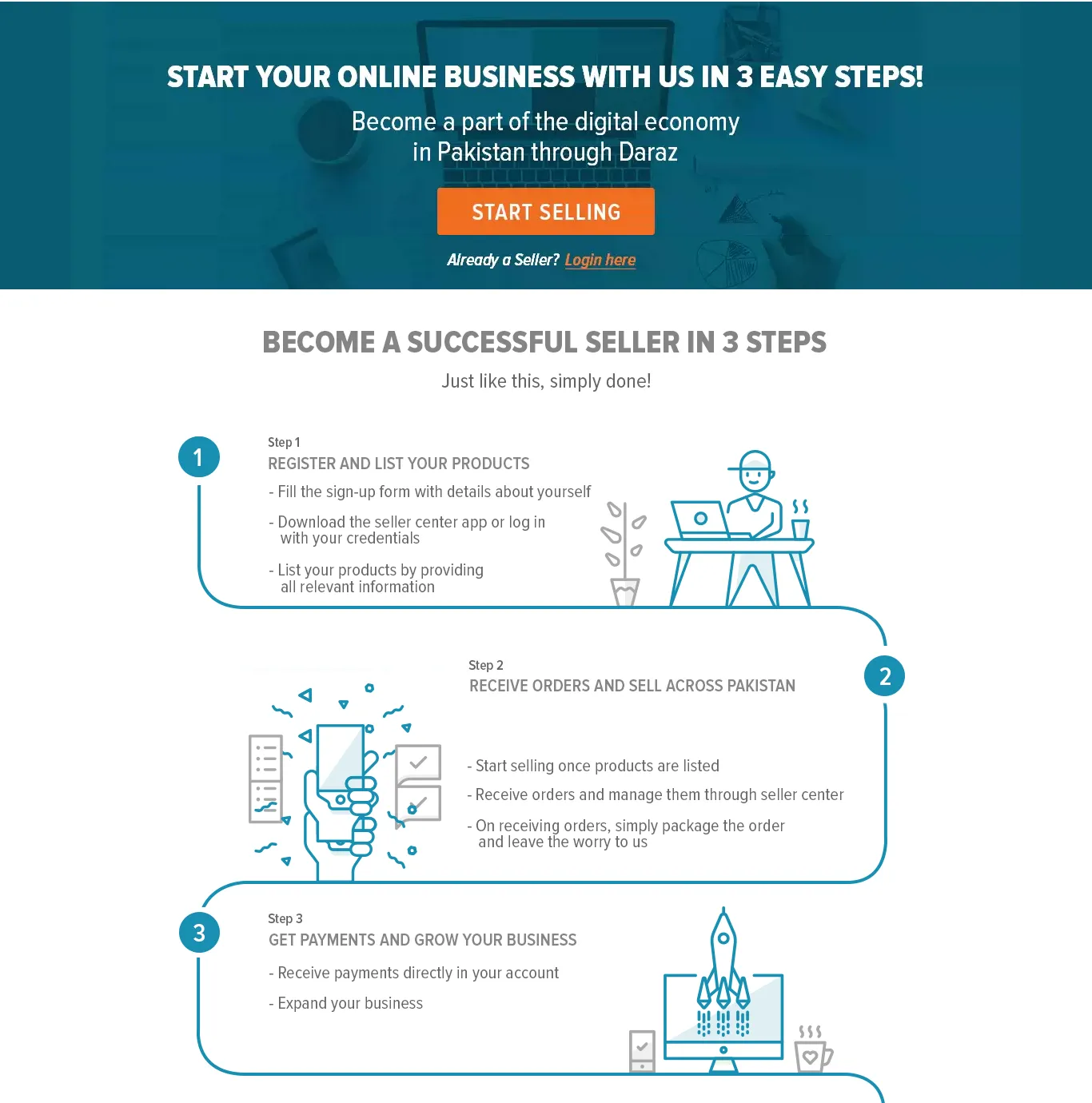
You register in Daraz Seller Center, list your products, receive orders, and Daraz collects the customer's payment and pays you later after deducting commission. Daraz's "Sell on Daraz" page describes it as three steps: register and list, receive orders, get paid.
Registration
The Seller Center sign-up page asks for your mobile number and sends a one-time code (OTP) over WhatsApp. After that you fill in your seller details. Daraz's public pages that we could open do not list the exact documents, so we cannot confirm them. Blogs written by third parties usually mention a CNIC for an individual seller or an NTN (National Tax Number) for a registered business, plus a bank account in the same name. Treat that as unconfirmed and read the checklist inside Seller Center before you start.

Listing and selling
You list products yourself, and the Marketplace Agreement says the information must match the physical product. The "Sell on Daraz" page says there is no listing fee. When orders arrive you pack them and hand them over according to the fulfilment model you chose. The agreement describes two: Dropship, where you keep stock and send orders out, and Daraz Express, where your stock is stored at a Daraz fulfilment centre.
What does it cost to sell on Daraz?
Opening a Daraz shop has no listing fee according to Daraz, but Daraz takes a commission from each sale, and the rate depends on the product category. We do not quote a percentage here because the schedule is category-specific and Daraz can change it.
The Daraz Marketplace Agreement explains the money flow in plain terms:
- Commission Schedule. A table of commission by product type, viewable under Marketplace Commission Structure in Daraz University (the seller learning hub).
- Notice of change. Clause 7.4 says Daraz may adjust the percentage with "suitable notice of 14 days in advance".
- Deductions. Under Payments, Daraz pays the Listed Price it received from the customer, less commission, less any service fees or penalties, less any other amounts due.
- Optional services. The definitions say Fees can be charged for additional services such as pickup or returns.
- Taxes. Clause 8.11 says the seller is responsible for sales tax and other duties on the supply, and clause 8.9 lets Daraz deduct or withhold taxes the law requires.
So your real cost is not one number. It is commission, plus fees and penalties, plus what you pay for packaging and your own time, plus any promotion discounts you fund. Work it out per product with the formula in the table later in this guide.
Confirm tax with a professional
The agreement puts sales tax responsibility on the seller. Whether and how you must register for sales tax or income tax depends on your business type, sales and province. Confirm with FBR, your provincial revenue authority or a tax adviser before you rely on any blog, including this one.
When and how do you get paid by Daraz?
According to the Marketplace Agreement, Daraz receives all customer payments on your behalf and pays you by online transfer to your bank account in Pakistani rupees, on a bi-monthly basis, and not less than 15 days after the product was delivered. That delay is the most important cash-flow fact for a small seller.
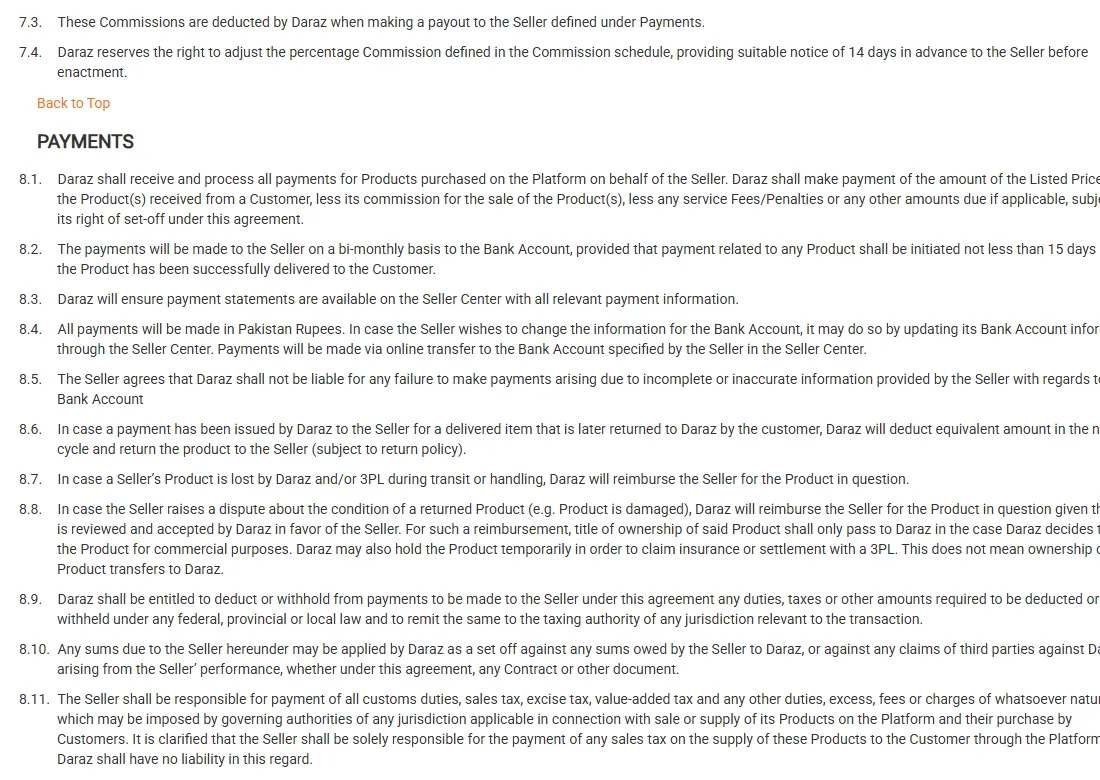
Read the clauses in the screenshot with these points in mind:
- Timing (8.2). Payment is initiated no sooner than 15 days after delivery. Say a customer receives your parcel on the 3rd: your money cannot be initiated before the 18th, and then it waits for the next payout cycle.
- Returns (8.6). If an item you were already paid for is later returned, Daraz deducts the amount from the next payout and returns the product to you, subject to its return policy.
- Set-off (8.10). Daraz may offset what it is owed against your payouts.
- Statements (8.3). Payment statements are available in Seller Center, so download and reconcile them against your own records.
- Wrong bank details (8.5). Daraz is not liable for payment failures caused by incomplete or inaccurate bank information.
Compare that with your own store, where a card or wallet payment from a gateway reaches you on the gateway's schedule, and a COD order is settled when the courier pays you out. Either way you should know the timing before you promise suppliers a payment date. Our guide to payment gateways in Pakistan covers the own-store side.
What do you give up on Daraz, and what do you get?
You get traffic, trust and logistics that would cost a lot to build alone. You give up control over pricing, placement and the customer relationship. This is a trade, not a trap, as long as you know which side of it you are paying for.
What you get
- Existing demand. Daraz's Seller Center page states 5 million monthly active users. That is Daraz's own claim and we could not verify it independently, but shoppers clearly start their search there.
- A fast start. No website, no domain, no payment gateway integration, no ad budget on day one.
- Collection of payments. Daraz receives the customer payment on your behalf and pays you through the cycle above.
- Logistics options. The agreement describes Daraz Express, where your stock sits at a Daraz fulfilment centre.
What you give up
- Price freedom. The agreement defines the Listed Price as not higher than the price you offer the same product through your own channels. In plain words, you cannot charge more on Daraz than on your own site.
- Placement. How and where your product is featured is, per the agreement, Daraz's decision. You compete beside many similar sellers.
- The customer relationship. The Confidentiality section says customer information is confidential and may be used by the seller solely for the purposes of the agreement, not shared with third parties without Daraz's consent. Read that as a limit on using Daraz buyers for your own marketing; check the exact text with a lawyer.
- Delisting risk. Daraz reserves the right to delist or downgrade sellers on its quality assessment, and to terminate after a default. A shop built only on one marketplace stops the day the account does.
- Customer service deadlines. Complaints forwarded by Daraz must be answered within 48 hours, or the product or seller can be delisted.
What does an own online store give you, and what does it cost?
An own store gives you the full margin, the customer list and the brand, but you must bring the traffic yourself. It is a better long-term asset and a slower start.
The two common platforms are Shopify and WooCommerce.
Shopify
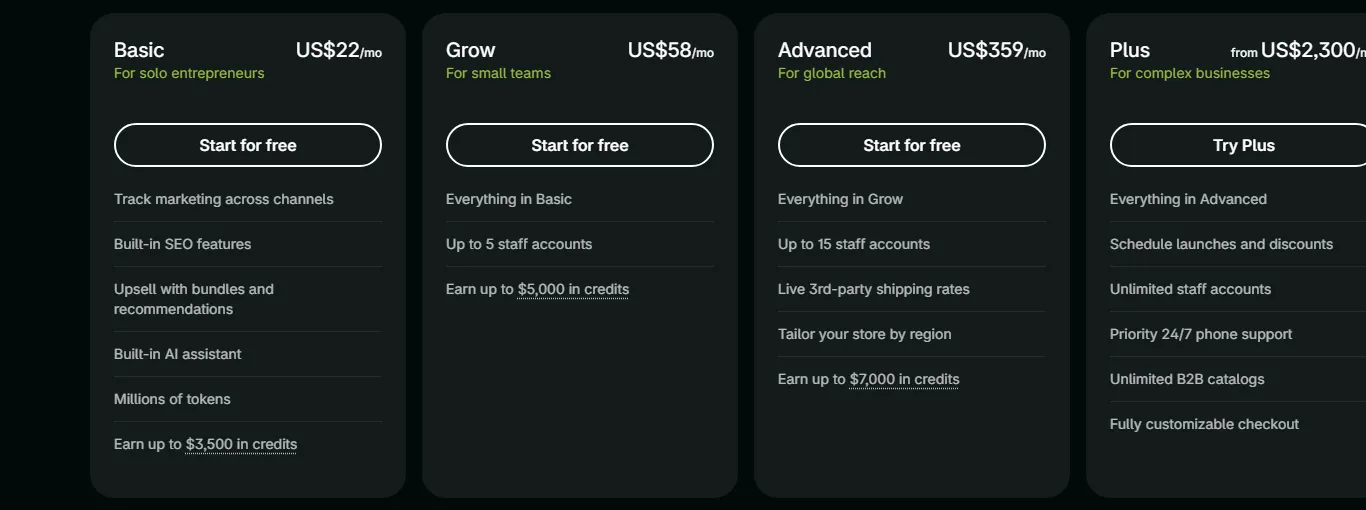
Shopify is a hosted store builder. On its pricing page, as of 17 November 2026 and with the "pay yearly" option shown, the plans were Basic at US$22 a month, Grow at US$58 and Advanced at US$359. Shopify also advertised a trial of 3 days free then US$1 a month for 3 months. Prices are in US dollars, so your cost in rupees moves with the exchange rate, and a card payment to a foreign company may carry tax; see our note on card payments abroad.
WooCommerce
WooCommerce is an open-source store system that runs on WordPress. Its official page says it is free to download and has no monthly platform fees. You still pay for hosting, a domain, a theme or design work and any paid extensions, so "free" means the software only.
Payments on your own store
Shopify Payments, Shopify's own card processor, is not available in Pakistan: the supported countries list names 41 countries and Pakistan is not among them. Shopify's help page on manual payments lists cash on delivery as a common manual method, and says orders stay unpaid until you mark them paid. For online cards and wallets, ask each local gateway whether it supports your platform before you commit. Our Shopify store in Pakistan guide walks through this setup step by step.
On your own store, one risk is yours alone: fake or abusive COD orders. On your store you handle it yourself. Read our guide on fake COD orders and Meta Pixel tracking before you spend on ads.
Daraz seller account vs own store: how do they compare?
The table sets the two side by side on the points that decide your profit. Daraz details come from its Marketplace Agreement and seller pages (17 November 2026); own-store details come from Shopify and WooCommerce's official pages.
| Question | Daraz seller account | Own online store |
|---|---|---|
| Setup effort | Register in Seller Center, then list products | Choose a platform, design, add products, set payments and delivery |
| Upfront fees | No listing fee per Daraz; commission on sales | Platform plan or hosting, domain, design work (Shopify plans quoted in US$) |
| Cost per sale | Commission by category, plus any fees or penalties | Gateway charges, ad cost to bring each buyer |
| Traffic | Built in, but shared with competing sellers | You must create it (ads, SEO, WhatsApp, social) |
| When you get paid | Bi-monthly, not less than 15 days after delivery | Depends on gateway or courier settlement |
| Pricing control | Listed Price not above your own-channel price | Full control |
| Customer data | Daraz holds it; seller use is limited by the agreement | You own the list (follow privacy rules) |
| Brand control | Shown as the seller; layout and placement set by Daraz | Your design, your story, your packaging inserts |
| COD handling | Daraz receives customer payments and settles through its cycle (the agreement does not mention COD by name) | You arrange couriers and handle fake orders and returns |
| Account risk | Delisting or termination possible under the agreement | Platform or ad account issues, but the store and list remain yours |
If you have only a few products and no marketing budget, the left column wins early. If you have a repeatable product, a good margin and a plan to keep buyers, the right column wins over time.
How do you decide: a simple scoring method
Count how many of the statements below are true for you. Mostly "A" answers point to Daraz first; mostly "B" answers point to your own store first; a mix points to the hybrid plan in the next section.
- Do you already have buyers? A: no, nobody knows my brand. B: yes, customers ask me on WhatsApp or Instagram. Common mistake: counting followers as buyers.
- What is your margin? A: thin and the product is a commodity, so price is the only difference. B: healthy, and the product is branded or hard to compare. Work out the margin after commission and returns, not before.
- Do customers buy again? A: one-time purchases, such as a phone case. B: repeat purchases, such as skincare, food or clothing. Repeat buyers are worth far more on your own list.
- Can you wait for your money? A: yes, I can fund stock for a few weeks. B: no, I need cash quickly. Be honest, because a 15-day delay plus the payout cycle can strain stock buying.
- Can you run ads? A: no budget or time. B: yes, I can test Facebook or Google ads and learn from the results. An own store without traffic earns nothing.
- Is your catalogue large? A: yes, many items where search matters. B: no, a small tight range that tells a story.
No score is a guarantee. Treat it as a way to see where your risk sits before you spend.
What is the best hybrid plan: Daraz for reach, own store for margin?
A hybrid plan uses Daraz to find buyers and your own store to keep them. The marketplace gives you proof that people want the product, and the store gives you the margin and the relationship. Check the agreement before you promote your store to Daraz customers: because of the confidentiality terms, do not take or use buyer data from Daraz orders for your own marketing.
- Start with your best three to five products on Daraz. Use the listing to learn which photos, titles and prices work. Done looks like: orders arrive and you know your return rate.
- Build your own store in parallel. A simple Shopify or WooCommerce store with COD and one online payment option is enough. Mistake to avoid: waiting for a perfect design. Launch small.
- Keep the Daraz price equal to or above your own price. The agreement's Listed Price definition ties them, so never undercut Daraz buyers on your own site in a way that breaks the rule. Read the exact wording again before you set prices.
- Drive new buyers to your store from channels you own. Facebook and Instagram ads, Google search, WhatsApp and your offline customers. Our e-commerce survival plan covers how to cut ad waste.
- Capture first-party data legitimately. Collect phone numbers and consent on your own store, by a WhatsApp opt-in at checkout or a discount for joining your list. This is data you can market to.
- Track both channels in one sheet. Record sales, commission, returns, ad cost and net profit per product, per channel, every week.
- Review after 90 days. Move budget and stock toward the channel with the higher net profit per order.
What mistakes should you avoid when choosing between them?
The biggest mistakes are putting everything on one channel, ignoring the true cost per order and skipping the fine print. Each one is cheap to avoid.
- Relying on a single marketplace. The agreement lets Daraz delist or terminate. If it is your only channel, one decision stops your business.
- Quoting the 0% commission offer as your margin. A time-limited promotion is not a long-term cost. Model the normal commission for your category.
- Forgetting returns in the payout maths. A returned order is deducted from the next payout, so a high return category can shrink cash fast.
- Launching an own store without traffic. A website is a shop in an empty street until you send people to it.
- Ignoring tax. The agreement makes sales tax your responsibility. Ask a tax adviser or your provincial authority what applies.
- Trusting hearsay on rules. Marketplace rules change. Read the live agreement and Seller Center notices, not a forwarded WhatsApp message.
- Copying Daraz customer data into your marketing tools. That may breach the agreement. Build your own list with consent instead.
What is a 30-day plan you can copy?
In 30 days you can have both channels live and know which one earns more per order. Copy this list and tick it off.
- Days 1 to 3: Decide your three to five hero products. Calculate cost, packaging and delivery per unit.
- Days 4 to 7: Read the Marketplace Agreement and the commission schedule for your category. Check which documents Seller Center asks for and register.
- Days 8 to 12: Photograph and list the hero products on Daraz with accurate descriptions.
- Days 8 to 14 (in parallel): Pick your store platform, buy the domain and set up COD plus one online payment method.
- Days 15 to 18: Launch the store. Add a WhatsApp number, a returns policy and a simple privacy notice.
- Days 19 to 25: Send a small test budget of ads to the store. Record cost per order.
- Days 26 to 30: Compare net profit per order on both channels. Keep what works, fix what does not.
Keep a note of dates: your first Daraz payout may arrive well after your first sale, so do not judge the channel by bank balance in week two.
How can Digitt Hype help?
If you decide your own store is worth building, our team can plan and build it with you. As a web development company in Pakistan, we set up Shopify and WooCommerce stores with COD, local payment options, tracking and a launch checklist, and we can help you connect it to the ads and WhatsApp flows that bring buyers in. See our e-commerce industry page for how we work, or contact us with your product list and we will tell you honestly whether a store, a Daraz-only start or both fits your stage.
Frequently asked questions
How do I sell on Daraz?
Register in Daraz Seller Center with your mobile number, complete your seller details, list your products with accurate information, then receive and pack orders. Daraz collects the customer payment and pays you after deducting commission. Check Seller Center for the current document list before you apply.
Is it free to open a Daraz seller account?
Daraz states there is no listing fee, but it charges a commission on each sale, and the rate depends on your product category. The Marketplace Agreement also mentions fees for extra services such as pickup or returns. Check the commission schedule in Daraz University for your category.
How long does Daraz take to pay sellers?
According to the Marketplace Agreement, payments are made bi-monthly to your bank account, and payment for a product is initiated not less than 15 days after successful delivery. Returned items already paid are deducted from the next payout. Confirm current terms in Seller Center.
Is it better to sell on Daraz or on my own website?
Daraz is better for a fast start with no traffic of your own. An own website is better for margin, customer data and brand control. Many Pakistani sellers use both: Daraz to reach new buyers, their own store to keep repeat customers.
Can I sell the same product on Daraz and my own store?
Yes, but the Marketplace Agreement says the Daraz Listed Price must not be higher than your price on your own channels. Set your own store price equal to or above the Daraz price, and read the agreement's exact wording before you publish prices.
Can I use Daraz customers' details to market my own store?
Probably not. The agreement says customer information is confidential and may be used by the seller solely for the purposes of the agreement. Build your own list with a WhatsApp opt-in or checkout consent instead, and ask a lawyer if you are unsure.
Does Shopify work in Pakistan?
You can run a Shopify store from Pakistan, but Shopify Payments is not available here. Shopify supports manual payment methods such as cash on delivery, and local gateways may offer their own integrations. Check each gateway's own page before you commit.
Sources 7
- Daraz: Sell on Daraz (3 steps, no listing fee, commission by category)
- Daraz Seller Center: sign-up page
- Daraz: Marketplace Agreement (commission, payments, confidentiality, delisting)
- Shopify: Pricing
- Shopify Help: Shopify Payments supported countries
- Shopify Help: Manual payments (cash on delivery)
- WooCommerce: official site
Numbers not matching your dashboard?
That gap is worth an hour of someone’s time. Tell us what you see and we will look at it with you.