Quick answer
ERP software price in Pakistan has no single figure, because you pay for four things: licence or subscription, implementation, customisation and yearly support. Published vendor prices are in US dollars, and implementation often costs more than the software. Compare quotes on three-year total cost, not the sticker price.
Key takeaways
- The software licence is usually the smallest part of an ERP bill; implementation, data migration, training and support add the rest.
- ERPNext and Odoo publish their prices in US dollars, not PKR, so your real cost depends on the exchange rate and on how you pay.
- Open-source does not mean free: you still pay for hosting, setup and someone to look after it.
- A custom build costs more up front but can be cheaper over several years if you need many users or very specific workflows.
- Ask every vendor for a three-year total cost in writing, with a list of what is not included.
How much does ERP software cost in Pakistan?
The honest answer is that the ERP software price in Pakistan depends on how you buy it, and the software itself is rarely the biggest cost. ERP (enterprise resource planning) is one system that links your stock, sales, purchases, accounts and staff, so everyone works from the same numbers instead of separate Excel sheets.
Most of the big names publish prices in US dollars. We checked the official pages on 17 November 2026 and none of the pages we opened showed a PKR price. We will not guess a rupee figure for you. Instead, this guide shows you the pricing models, the cost parts that quotes hide, and how to compare offers. If you want the basics first, read our guide to moving from Excel to ERP and POS vs ERP: what your business needs.
Here is the short version. You can pay in four ways: a monthly or yearly subscription, a one-time perpetual licence, free open-source software plus a paid implementer, or a system built just for you. Each one moves cost to a different place. Read on to see where.
What are the four ways to pay for an ERP system?
You can buy ERP as a per-user subscription, a perpetual licence, open-source software with paid setup, or a custom build. The model you pick decides when you pay and who owns the system.
1. Per-user subscription (SaaS)
You pay a fee each month or year for every person who logs in. The vendor hosts the system and runs updates. Odoo Online works this way. It is easy to start, but the bill grows with every new user and you never own the software.
2. Perpetual licence
You pay once to use a specific version, then a yearly fee for support and updates. This model is common in older, locally installed accounting and ERP packages. Ask what happens to your data and your right to use the software if you stop paying support.
3. Open-source plus implementation
Open-source means the code is public and licensed so anyone can run it. ERPNext is released under the GPL-3.0 licence and the Odoo source code under LGPLv3, as shown on their public GitHub pages. You do not pay a licence fee for that code, but you do pay for hosting and for a partner to set it up, as the next sections explain.
4. Custom build
A developer writes software to your exact process, often with Laravel and MySQL. You pay a project fee, then a smaller fee for hosting and maintenance. You own the code if the contract says so. This is the most flexible model and the one where a clear scope matters most.
What do ERPNext and Odoo actually charge?
As of 17 November 2026, Frappe lists ERPNext hosting from US$5 a month and Odoo lists plans per user per month in US dollars. These are reference points only. Neither page gave a PKR price.
ERPNext and Frappe Cloud
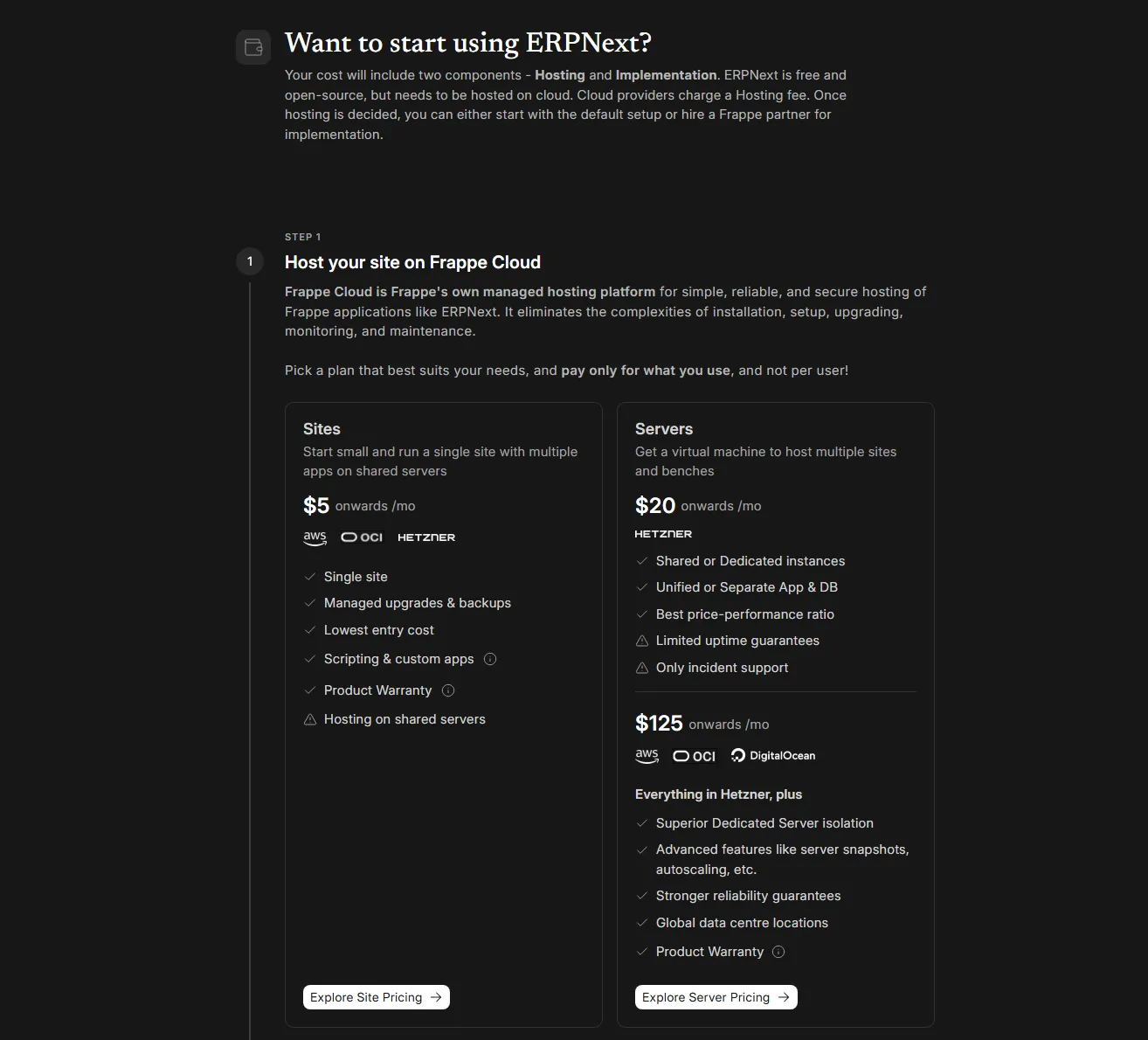
ERPNext is free, open-source ERP made by Frappe. Its pricing page says your cost has two parts: hosting and implementation. It lists Frappe Cloud site hosting from US$5 a month, server plans from US$20 a month and a higher server tier from US$125 a month, and says you pay for what you use, not per user. A company that wants help can hire a Frappe partner, and there is a custom enterprise quote.
Odoo
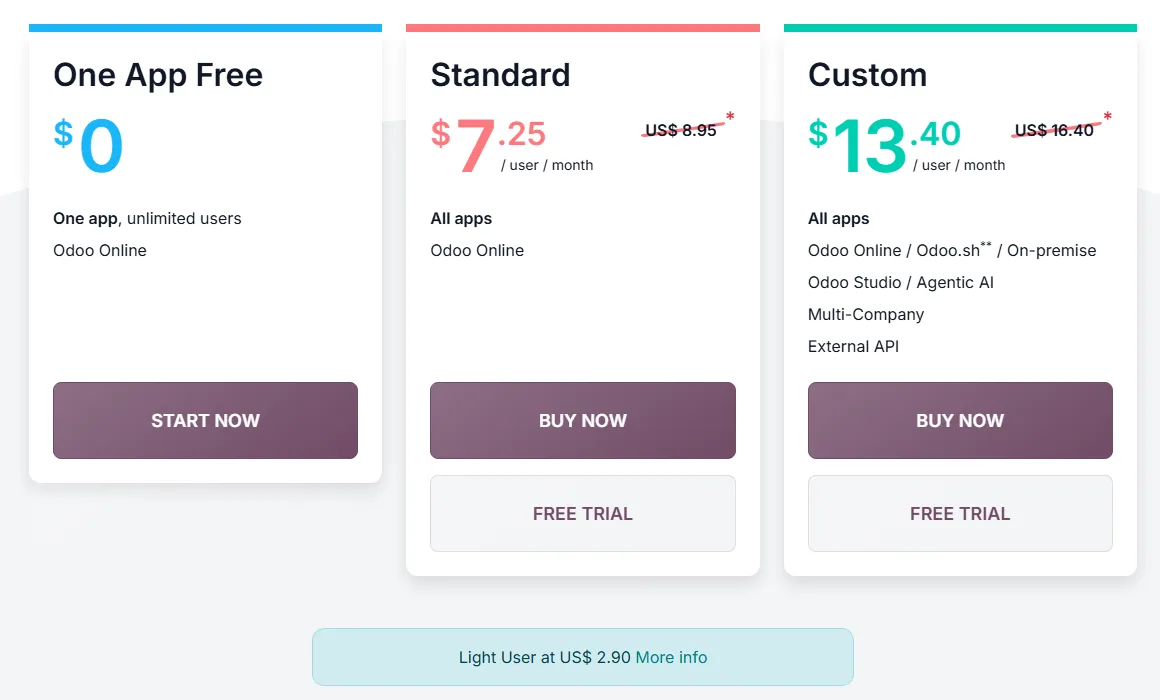
Odoo offers One App Free (one app, unlimited users), a Standard plan and a Custom plan, both priced per user per month. On our capture the page showed US$7.25 for Standard and US$13.40 for Custom, with US$8.95 and US$16.40 crossed out beside them and an asterisk marking a discount. Our earlier article on 9 November saw different figures, so the page changes with billing term and offers. Read the live page before you budget. The page also says its plans include hosting and maintenance, but not implementation services or maintenance of custom code.
Dollar prices, rupee bills
A US$ subscription paid from a Pakistani card can add card tax and bank charges, and the rate moves every month. See our guide on card payments and tax for foreign subscriptions. Confirm the tax treatment of a foreign software invoice with a tax adviser.
Is open-source ERP really free?
No. Open-source ERP has no licence fee, but it still costs money to host, install, set up and support. The ERPNext pricing page says so directly.
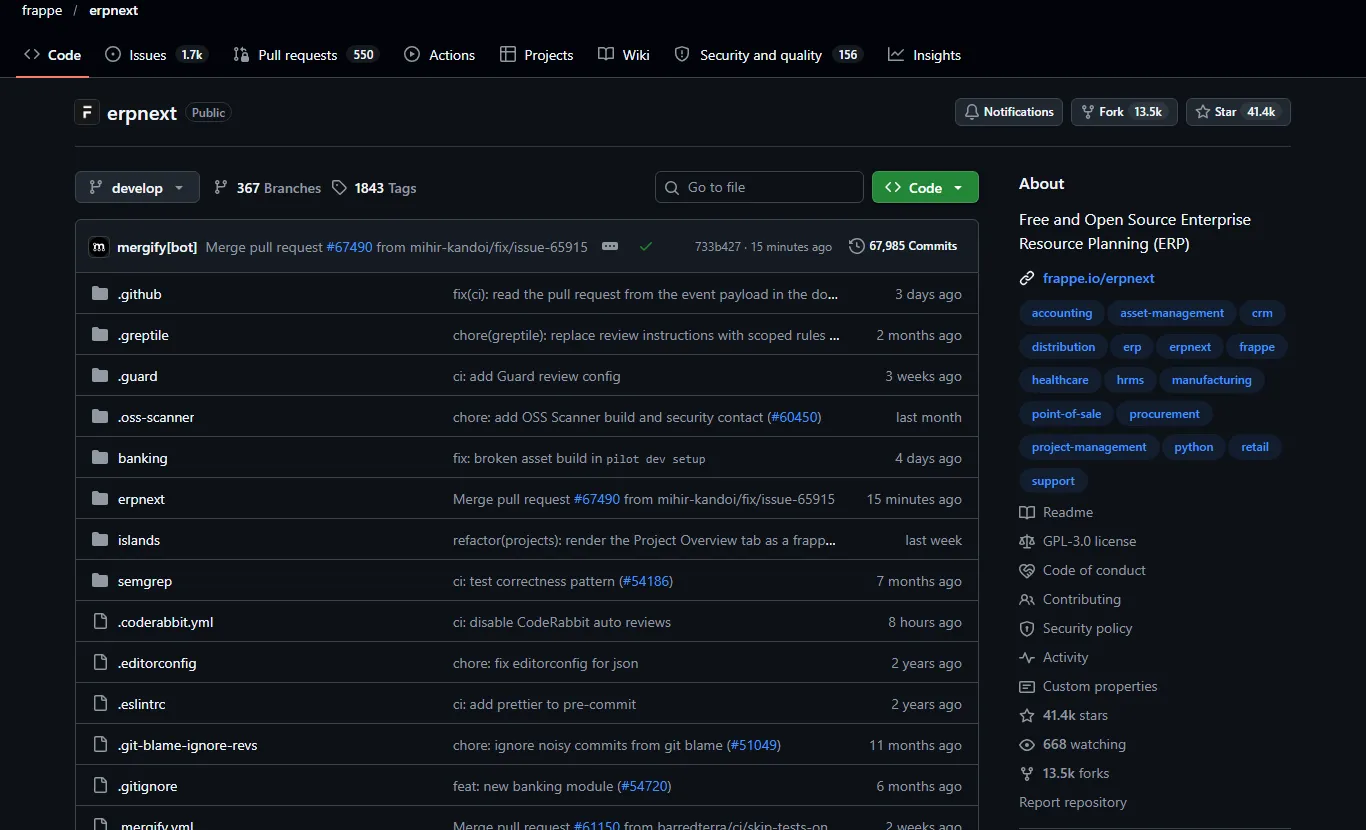
The public repositories show the licences. ERPNext lists GPL-3.0 on its GitHub page and Odoo\'s repository carries an LGPLv3 licence file. Both licences let you run the software without paying the vendor. Neither licence pays for your server, your data clean-up or the person who fixes a broken report at 9 pm on the last day of the month.
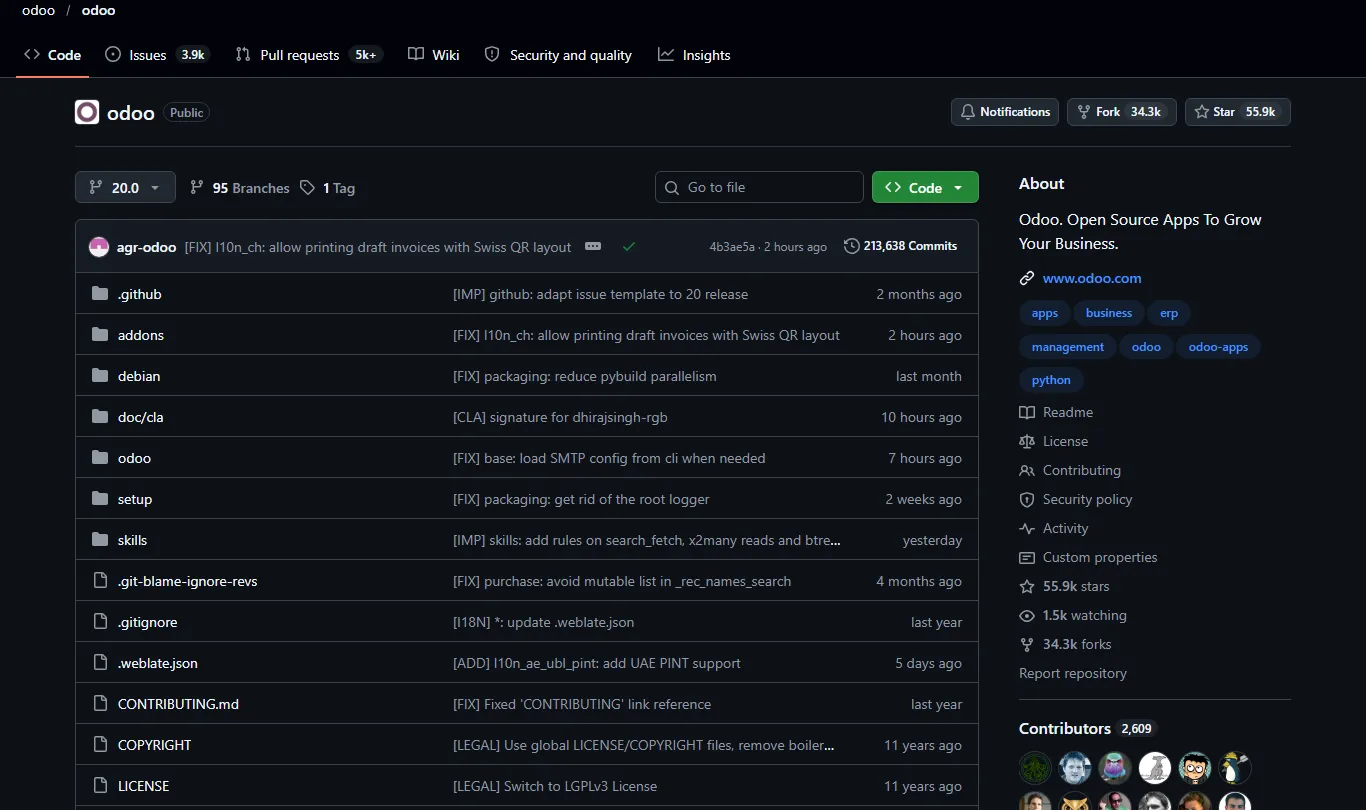
A practical rule: if nobody in your company can maintain open-source software, the "free" saving moves to a partner\'s invoice. That is fine, as long as you know it before you sign.
Why does implementation cost more than the software?
Implementation costs more because an ERP is a way of working, not a download. Someone has to map your process, load your data, set up users and train your staff. That is human time, and human time is what partners charge for.
Both vendor pages above draw the same line. Frappe splits cost into hosting and implementation. Odoo says its plans do not cover implementation services. So whichever system you pick, ask for implementation as a separate line in the quote.
Here is where the money goes in a typical project. These are cost parts, not prices.
| Cost part | What it covers | Often forgotten? |
|---|---|---|
| Licence or subscription | The right to use the software, per user or per company | No |
| Implementation | Setup, chart of accounts, items, warehouses, users, roles | Sometimes |
| Data migration | Cleaning and loading customers, suppliers, items, opening balances | Yes |
| Customisation | Custom print formats, reports, approvals, integrations | Yes |
| Training | Sessions for accountants, store staff, owners; Urdu material | Yes |
| Hosting | Server or cloud plan, backups, security updates | Yes, if self-hosted |
| Support and upgrades | Fixes, new versions, help desk hours | Yes |
| Internet and power backup | Stable line, UPS or generator at the shop or warehouse | Almost always |
Data migration deserves special attention. If your item list has the same product spelled three ways, your ERP will have it three ways too. Clean it in Excel first. It costs you a few days and saves the partner many billed hours.
When does a custom ERP cost less than a licence?
A custom ERP can cost less over several years when you have many users, a process that packaged software does not fit, or a need to connect to local systems. It costs more up front, so it only wins if you keep it for years.
Per-user pricing is the key. Say a company pays a subscription for 40 users. Every new hire adds to the bill, forever. A custom system usually has no per-user fee, so cost stays flat as you grow. A shop with three users has the opposite problem: a subscription is far cheaper than paying a developer to build from zero.
Signs a licence is the better fit
- You are a trader, wholesaler or light manufacturer with normal processes.
- You have fewer than about ten users and want to start next month.
- You do not want to own software maintenance.
Signs a custom build is worth a quote
- Your workflow is unusual: for example, rates that depend on route, customer tier and season.
- You need to connect POS, WhatsApp orders, delivery riders and invoicing in one place.
- You must follow a tax or invoicing scheme that packaged software handles badly. See our FBR digital invoicing guide before you decide.
- You will have dozens of users, so per-user fees add up.
There is also a middle path: open-source ERP with custom modules written on top. You keep the proven base and pay only for the parts that are special to you. Ask any partner to quote this alongside a full custom build.
What about accounting software price in Pakistan?
Accounting software is cheaper and narrower than ERP. It handles ledgers, invoices, payments and tax reports, while ERP adds stock, purchasing, production and HR. If all you need is bookkeeping, start here.
In Pakistan you will meet three categories. First, global cloud tools priced in US dollars per month. Second, local cloud products, some priced in PKR. Third, older desktop packages that many accountants know well. We have not opened enough vendor price pages to quote their numbers here, so check each vendor\'s own page and ask for the price in writing. Our earlier ERP guide lists examples that publish prices.
Test any package on three jobs before you pay: raise a sales-tax invoice, record a supplier payment with a part payment, and print a trial balance for last month. If it cannot do those without a workaround, keep looking.
What is the best ERP software in Pakistan?
There is no single best ERP for every Pakistani business. The best one is the system your team will use daily, that fits your process and that you can afford over three years. We do not rank vendors; here is how to judge them yourself.
| Question to ask | Why it matters |
|---|---|
| Can it handle my tax and invoice format? | A wrong invoice layout means rework or notices, not just annoyance. |
| Does it work on weak internet and during load shedding? | Stores and warehouses lose signal. Ask about offline mode and backups. |
| Is Urdu or Roman Urdu support available for staff? | Adoption fails when the storekeeper cannot read the screen. |
| Who can fix it locally, and how fast? | Support in your time zone and language beats a ticket queue abroad. |
| Can I export all my data at any time? | This protects you if you change vendor. |
| What is not included in the quote? | Hidden extras are where budgets break. |
For a retailer or restaurant that needs counter billing as well as stock, check whether you need ERP at all, or a POS with stock features. Our POS and ERP page explains the difference, and the restaurant and e-commerce pages show what each sector typically needs.
How do I work out the total cost of ownership?
Total cost of ownership (TCO) is everything you pay over a fixed period, usually three years. Add up one-time costs and yearly costs for each option, then compare the totals. Do it before you look at any sticker price.
- Count your users honestly. List every person who needs to log in now and in three years. Separate full users from people who only view reports. Common mistake: counting only the accountant.
- Ask for the same scope from every vendor. Give each one the same one-page list of processes: sales, purchases, stock, accounts, tax invoices, reports. Quotes only compare if the scope matches.
- Split every quote into one-time and yearly lines. One-time: setup, migration, training, customisation. Yearly: licence or subscription, hosting, support, upgrades.
- Add the costs outside the quote. Barcode scanners, printers, tablets, extra internet, UPS, staff time during migration and any foreign-currency card or tax effect on a US$ subscription.
- Multiply and compare. One-time plus three years of yearly costs. Do this in PKR with a stated exchange rate for any US$ line, and add a margin for the rate to move.
- Check the exit. Ask: can I export my data in a standard format, and who owns the customisations? A cheap system that traps your data is expensive later.
A worked example (hypothetical)
Say Option A charges Rs 400,000 for setup and Rs 150,000 a year, and Option B charges Rs 100,000 for setup and Rs 330,000 a year. Over three years A costs Rs 850,000 and B costs Rs 1,090,000. These numbers are made up to show the method. B looks cheaper in month one and costs more in year three.
What mistakes make ERP projects cost more than planned?
The common budget killers are an unclear scope, dirty data, too many customisations and skipping training. All four are in your hands before the project starts.
- Buying on the demo. A demo uses perfect sample data. Ask to test with a copy of your own items and invoices.
- Customising everything. Every custom screen is paid for once, then again at each upgrade. Change your process where reasonable and customise only what earns money.
- No single owner on your side. Pick one person who decides. Committees stall projects and run up billed hours.
- Going live everywhere on day one. Start with one branch or one module, run it beside Excel for a month, then expand.
- Ignoring support terms. Find out response times, support hours and what counts as a paid change versus a free fix.
- Verbal promises. If it is not in the contract, it is not included.
What is a 30-day plan to get a fair ERP quote?
You can get comparable ERP quotes in about 30 days if you prepare first. Use this plan and copy it into your notes.
- Days 1-5: write down your processes, users, branches, reports and tax needs on one page.
- Days 6-10: clean your item, customer and supplier lists in Excel. Remove duplicates and fix units.
- Days 11-15: shortlist three options: one subscription, one open-source with a partner, one custom build.
- Days 16-22: send the same one-page brief to each. Ask for one-time and yearly costs separately, plus a list of exclusions.
- Days 23-27: test each system with 20 real items and five real invoices. Ask staff who will use it to try it.
- Days 28-30: build the three-year TCO table, check references and exit terms, then choose.
Please confirm tax and legal points, such as how a software or subscription invoice is treated, with a qualified tax adviser or the relevant authority. This article describes pricing models; it is not tax advice.
How can Digitt Hype help with ERP cost and setup?
Digitt Hype builds and sets up POS and ERP systems for Pakistani businesses, and we can quote both a packaged route and a custom build so you can compare them on the same scope. If you are looking for a POS and ERP software company in Pakistan, we start by mapping your processes and listing what each option would cost over three years.
Our web development company in Pakistan team can also connect your ERP to your online store or website. Send us your one-page brief through the contact page and we will tell you honestly whether you need ERP, a POS or just better accounting software. We do not promise savings or results before we see your process.
Frequently asked questions
How much does ERP software cost in Pakistan?
There is no single price. Vendors publish US-dollar prices, for example ERPNext hosting from US$5 a month and Odoo plans per user per month as of 17 November 2026, and implementation, migration, training and support are extra. Compare quotes on three-year total cost.
Is ERPNext free to use in Pakistan?
The ERPNext software is free and open-source under the GPL-3.0 licence, so there is no licence fee. You still pay for hosting, either your own server or a plan such as Frappe Cloud, and usually for an implementation partner to set it up.
How much does Odoo cost per user?
On 17 November 2026 Odoo listed Standard and Custom plans per user per month in US dollars, plus a free plan for one app. Figures change with billing term and offers, so check the live pricing page. Implementation is not included in the plans.
What is the difference between ERP licence and custom ERP cost?
A licence or subscription is cheaper to start but grows with each user and keeps you on the vendor's features. A custom ERP costs more up front, fits your exact process and usually has no per-user fee, so it can win over several years.
What is ERP implementation cost?
ERP implementation cost is what you pay for setup, data migration, customisation and training, separate from the software. Vendor pages for ERPNext and Odoo both treat it as separate from hosting or the subscription, so always ask for it as its own line.
What is the best ERP software in Pakistan for a small business?
No single system is best for everyone. Choose the one that handles your tax invoices, works on weak internet, has local support and lets you export your data. Test two or three options with your real items before you commit.
Is accounting software enough, or do I need ERP?
If you only need ledgers, invoices and tax reports, accounting software is enough and costs less. You need ERP when stock, purchasing, production or several branches must work from one set of numbers.
Sources 7
Numbers not matching your dashboard?
That gap is worth an hour of someone’s time. Tell us what you see and we will look at it with you.